Enabling Local Manufacturing for an AI-Powered Gaming Device

Client Overview
A leading consumer robotics & gaming company focused on creating interactive, AI-powered learning experiences for children approached Rapidise to support the localization and scale-up of one of its flagship products – an intelligent companion robot designed to make learning engaging, conversational, and adaptive.
The product combined advanced electronics, embedded systems, mechanical assemblies, and AI-driven interaction capabilities, making manufacturing consistency and assembly precision critical to performance.
The product combined advanced electronics, embedded systems, mechanical assemblies, and AI-driven interaction capabilities, making manufacturing consistency and assembly precision critical to performance.
Background
As the product scaled across markets, the client wanted to move towards a more reliable and self-sustained manufacturing ecosystem in India. While the product itself had achieved strong market traction, the production process was still heavily dependent on Chinese manufacturing support, limiting operational flexibility and scalability.
The absence of structured manufacturing documentation, assembly visibility, and standardized workflows made local production difficult to streamline. To support future growth, the client required a partner capable of understanding the product at a deeper engineering level and building a production-ready manufacturing foundation from the ground up.
Rapidise was brought in to bridge this gap, helping transform a complex, externally dependent manufacturing setup into a structured and scalable local production ecosystem.
The absence of structured manufacturing documentation, assembly visibility, and standardized workflows made local production difficult to streamline. To support future growth, the client required a partner capable of understanding the product at a deeper engineering level and building a production-ready manufacturing foundation from the ground up.
Rapidise was brought in to bridge this gap, helping transform a complex, externally dependent manufacturing setup into a structured and scalable local production ecosystem.
The Requirement
Rapidise was entrusted with:
The Challenges
Limited Clarity on Product Architecture
The existing production ecosystem lacked detailed clarity around assembly sequencing, structural dependencies, and manufacturing flow, making local execution difficult to standardize.
Critical assembly and quality procedures were not formally documented, resulting in dependency on external manufacturing know-how and limiting repeatability at scale.
Critical assembly and quality procedures were not formally documented, resulting in dependency on external manufacturing know-how and limiting repeatability at scale.
Complex Product Integration
The product involved multiple interconnected systems, including electronics, sensors, embedded modules, audio components, and precision-fit mechanical assemblies – all of which required careful coordination during production.
Need for Scalable Localization
The client needed to establish a dependable local manufacturing and sourcing ecosystem without compromising on product quality, consistency, or production efficiency. This involved building stronger visibility across components, assembly processes, and the local material supply chain to support scalable long-term production within India while reducing dependency on Chinese manufacturing ecosystems.
Rapidise’s Approach
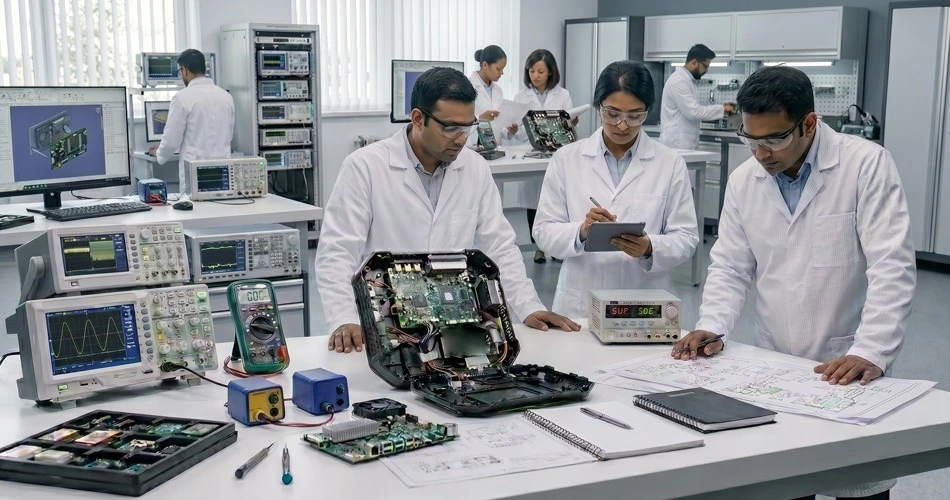
1. Product Understanding & Engineering R&D
Rapidise spent nearly 4-5 months conducting in-depth R&D to understand the product comprehensively from both an engineering and manufacturing perspective.
This included:
This included:
The objective was to convert a largely undocumented manufacturing setup into a clearly defined production system.
2. SOP & Process Development
Based on the learnings from the R&D phase, Rapidise developed structured SOPs covering:
This helped establish consistency, reduce production ambiguity, and improve operational control across manufacturing stages.
3. Production Framework Structuring
Rapidise further streamlined the manufacturing ecosystem by:
The focus was to build a manufacturing system capable of scaling sustainably.
4. Enabling Local Manufacturing Capability
A key aspect of the engagement was helping the client strengthen local manufacturing capability and reduce dependency on Chinese manufacturing ecosystems.
Rapidise helped create the operational and process foundation required to support long-term manufacturing continuity within India.
Rapidise helped create the operational and process foundation required to support long-term manufacturing continuity within India.
The Outcome
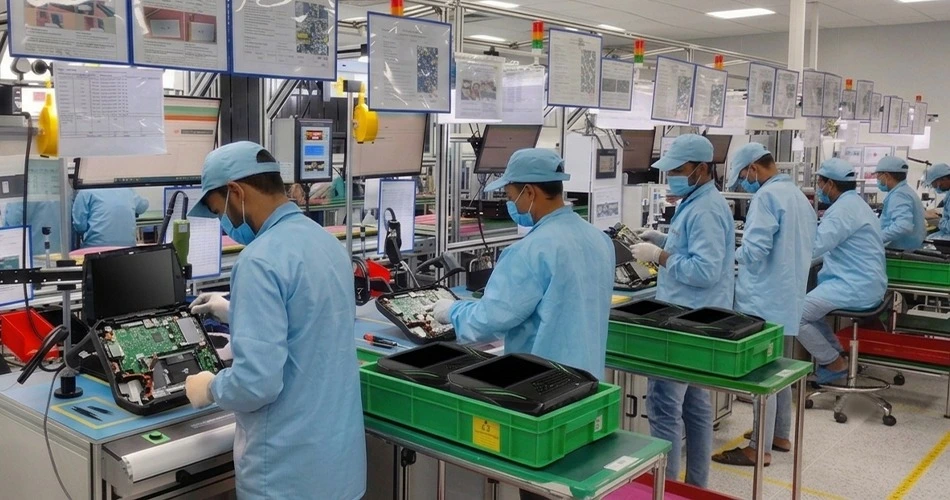
Structured Manufacturing Ecosystem
Rapidise transformed an unstructured production setup into a clearly defined and execution-ready manufacturing process.
Standardized SOPs & Quality Processes
The newly developed SOP framework improved assembly consistency, quality control, and production repeatability.
Improved Production Readiness
The client gained stronger process visibility, smoother assembly execution, and a more scalable manufacturing workflow.
Reduced External Dependency
By establishing localized production capabilities, the client achieved greater manufacturing control, flexibility, and operational confidence while significantly reducing dependency on Chinese manufacturing support.
Foundation for Future Scale
The engagement laid the groundwork for sustainable manufacturing growth, enabling the client to scale production more efficiently in the future.
Conclusion
For advanced robotics products, scaling manufacturing requires more than engineering innovation – it demands process clarity, production structure, and operational ownership.
Rapidise helped the client transition from a dependent manufacturing model to a more structured and scalable local production ecosystem, enabling a stronger manufacturing structure, ready for future growth.
Rapidise helped the client transition from a dependent manufacturing model to a more structured and scalable local production ecosystem, enabling a stronger manufacturing structure, ready for future growth.
Other Case Studies
No Case Studies Available Yet.