
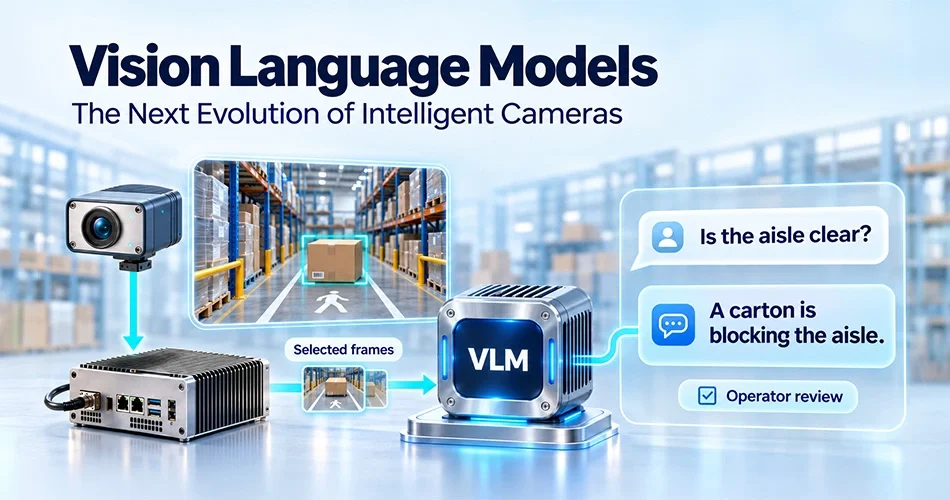
Traditional computer vision systems are usually designed around specific tasks: detect a person, count objects, identify a vehicle or classify a product. Vision language models are changing that approach by connecting visual understanding with language. Instead of only returning a label or confidence score, a system can interpret an image or video scene and relate what it sees to a natural-language instruction or question. This creates new possibilities for intelligent cameras, industrial monitoring and interactive visual systems.
What Makes Vision Language Models Different
VLMs combine information from images or video with language-based reasoning. A model can be asked to describe a scene, identify relevant objects, compare conditions or answer a question about what is happening. This does not mean every camera needs a large general-purpose model running continuously. In practical products, VLMs may work alongside smaller, task-specific models that perform fast detection and trigger deeper analysis only when necessary.
For intelligent cameras, a practical workflow is: an edge detector identifies an event → selected frames are sent to the VLM → a rule engine or operator reviews the result → only confirmed events trigger an important action. This avoids running a large VLM continuously on every frame.
VLMs in Manufacturing and Visual Inspection
The manufacturing sector can benefit from the same capability, but scene description should not be confused with calibrated quality measurement. A VLM can explain or contextualize a visible defect, while dimensional pass/fail decisions still require calibrated imaging, suitable inspection models and defined tolerances.
Hardware and deployment choices are important. For edge deployment, teams should measure model memory, input resolution, sustained latency, camera frame rate, power draw and thermal headroom on the target processor rather than relying only on advertised AI performance. Cloud deployment can provide more compute and access to larger models, while a hybrid design can keep routine detection at the edge and send selected frames for deeper analysis.
Testing and Operating VLM-Powered Systems
Data quality remains one of the biggest factors in real-world performance. Testing should cover factual errors in scene descriptions, prompt consistency, difficult lighting, occlusion, missed details and response time. Results should be compared with trusted detections, known ground truth or operator review where the output could affect safety, security or production decisions.
Businesses should also think about integration. A VLM-powered solution may need camera pipelines, embedded software, APIs, databases, alerting systems and user interfaces. Security controls are important when visual data is sensitive. For commercial products, teams also need a strategy for model updates, monitoring and version control. The goal is not simply to add a larger model, but to build a dependable system around it.
Operational Integration and Human Review
Another practical consideration is how the system will be operated after launch. Teams should define who reviews alerts, how visual questions are logged and how model performance is measured. A VLM can make an interface more natural, but it should not be treated as an unquestioned source of truth. Confidence thresholds, human review and clear escalation paths are useful when the result could affect safety, security or production decisions.
VLMs are likely to become another layer in the computer vision stack rather than an immediate replacement for every existing model. Their value is strongest when visual understanding and language-based interaction solve a real operational problem. Organizations that combine efficient perception models, suitable edge or cloud hardware and well-designed software can use multimodal AI to make cameras more useful, explainable and easier to interact with.
Engineering Considerations for VLM Deployment
A practical VLM deployment should define model memory limits, acceptable response latency, image size and frame rate, power and thermal limits, fallback behavior, logging, model-version control and secure update procedures. These requirements determine whether the workload belongs on an edge GPU/NPU, in the cloud or in a hybrid pipeline.
For production-ready multimodal vision systems, Rapidise can align AI models, embedded compute, camera pipelines and deployment software. Related capabilities: AI and ML development | security and surveillance solutions
Frequently Asked Questions
What are vision language models?
Vision language models connect visual inputs with language so an AI system can interpret images or video and respond to natural-language instructions or questions.
Are VLMs the same as computer vision models?
No. Traditional vision models often focus on defined tasks, while VLMs combine visual understanding with language-based reasoning and interaction.
Can VLMs run on edge devices?
Some optimized models can run on capable edge hardware, although model size, memory, latency and power requirements must be evaluated carefully.
How can VLMs improve intelligent cameras?
They can add richer scene interpretation, natural-language interaction and contextual analysis on top of conventional detection and tracking.
Build Smarter Computer Vision Solutions
Develop scalable Edge AI and Cloud AI solutions with Rapidise’s expertise in hardware, embedded software, and AI integration.
