
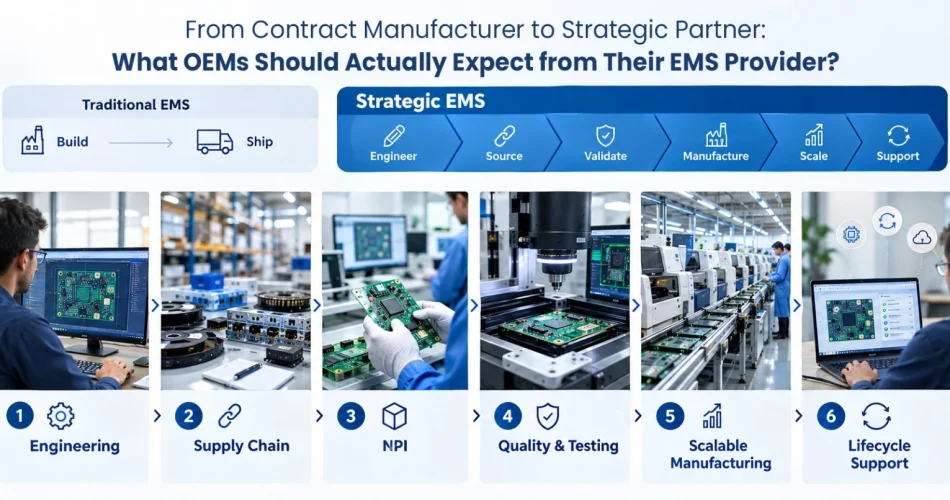
That model still exists. But for products with shorter development cycles, complex electronics and uncertain supply chains, many OEMs need more than assembly capacity.
The better question is not simply, “Can this EMS provider build our product?” It is, “What can this partner contribute before, during and after production?”
The better question is not simply, “Can this EMS provider build our product?” It is, “What can this partner contribute before, during and after production?”
Engineering Input Before Production
What should OEMs expect from an EMS partner before production starts? At minimum, practical feedback on manufacturability, testability, component choices and the production process.
An EMS provider should identify manufacturing issues before they become factory problems, including PCB layout, component selection, assembly constraints, testability and tooling.
DFM, DFA and DFT reviews are especially valuable when they happen early enough for the OEM to make changes without disrupting the launch schedule. The purpose is not for the manufacturer to take control of the product design. It is to bring manufacturing and assembly knowledge into decisions that will eventually affect production, helping ensure the product is designed for efficient assembly, reliable testing and smooth scalability.
An EMS provider should identify manufacturing issues before they become factory problems, including PCB layout, component selection, assembly constraints, testability and tooling.
DFM, DFA and DFT reviews are especially valuable when they happen early enough for the OEM to make changes without disrupting the launch schedule. The purpose is not for the manufacturer to take control of the product design. It is to bring manufacturing and assembly knowledge into decisions that will eventually affect production, helping ensure the product is designed for efficient assembly, reliable testing and smooth scalability.
A Real View of the Supply Chain
Supply chain management is another area where the relationship should go beyond purchase-order execution. Today’s EMS providers support business growth through supply chain expertise, design optimization and manufacturing excellence, helping reduce Total Cost of Ownership (TCO) and improve Time to Market (TTM). OEMs should expect visibility into component availability, lead times, lifecycle risks and alternatives. When a critical part becomes constrained or obsolete, the EMS provider should assess the impact, recommend solutions and support qualification. By selecting reliable components and managing obsolescence proactively, EMS partners reduce lifecycle risks, improve product reliability and strengthen long-term product success.
Clear NPI Ownership
New Product Introduction is where a strategic EMS relationship can show its value. A strong NPI process connects prototype builds, engineering reviews, pilot production, testing, quality and supply planning.
The objective is to enter volume production with known processes rather than discover basic problems after the ramp has started. OEMs should ask who owns the NPI schedule, how build issues are tracked, how corrective actions are closed and what information is provided before production release.
The objective is to enter volume production with known processes rather than discover basic problems after the ramp has started. OEMs should ask who owns the NPI schedule, how build issues are tracked, how corrective actions are closed and what information is provided before production release.
Scalability Without Losing Control
Moving from hundreds of units to thousands is not simply a matter of running the same process for longer. Production capacity, material planning, test throughput, operator training, inspection and logistics all have to scale together.
An EMS provider should therefore be able to explain how it manages the transition from pilot quantities to volume production. The answer should include more than the number of SMT lines available. It should cover yield, capacity planning, supplier readiness, test infrastructure and quality controls.
An EMS provider should therefore be able to explain how it manages the transition from pilot quantities to volume production. The answer should include more than the number of SMT lines available. It should cover yield, capacity planning, supplier readiness, test infrastructure and quality controls.
Quality Should Be Visible, Not Assumed
OEMs should also expect measurable quality information. Depending on the product, useful indicators may include first-pass yield, defect rates, rework, test failures, supplier quality and corrective-action closure.
A strategic partner should be willing to discuss problems openly. Hiding a production issue until the customer discovers it is a sign of a transactional relationship, not a strong one.
A strategic partner should be willing to discuss problems openly. Hiding a production issue until the customer discovers it is a sign of a transactional relationship, not a strong one.
Lifecycle Support Matters Too
Production is not the end of the relationship. Products may need engineering changes, component substitutions, firmware updates, cost reductions or field support.
An EMS provider with engineering capability can be useful during these stages because the people involved understand both the product and the manufacturing process.
Rapidise describes its manufacturing journey as covering product engineering, NPI, testing, supply chain coordination, mass manufacturing and delivery. That integrated model reflects the broader direction of EMS relationships, where manufacturing is increasingly connected with engineering and lifecycle support.
An EMS provider with engineering capability can be useful during these stages because the people involved understand both the product and the manufacturing process.
Rapidise describes its manufacturing journey as covering product engineering, NPI, testing, supply chain coordination, mass manufacturing and delivery. That integrated model reflects the broader direction of EMS relationships, where manufacturing is increasingly connected with engineering and lifecycle support.
What OEMs Should Ask Before Selecting an EMS Partner
A useful evaluation should include questions such as: How early will the EMS team review the design? What kind of support is provided for DFA, DFM & DFT? How are component risks identified? What happens when a critical part becomes unavailable? How is NPI managed from prototype to volume? Which quality metrics are shared regularly? How does the provider handle engineering changes? Can production scale without compromising traceability and quality? What support is available after the product is in the field?
These questions shift the discussion from unit price alone toward operational capability.
These questions shift the discussion from unit price alone toward operational capability.
Conclusion
A strategic EMS partner should reduce manufacturing uncertainty, not simply provide factory capacity. For OEMs, that means expecting engineering input, sourcing visibility, disciplined NPI, measurable quality, scalable production and support throughout the product lifecycle.
FAQs
What should an OEM expect from an EMS provider?
Beyond assembly, an OEM can expect engineering input, sourcing visibility, NPI support, quality reporting, production scaling and lifecycle assistance.
How do you choose the right EMS partner?
Look at engineering capability, DFM, DFA and DFT support, sourcing processes, NPI management, testing, quality systems, scalability and communication—not price alone.
What should a strategic EMS partner provide during NPI?
The provider should help coordinate technical reviews, prototype builds, material readiness, testing, corrective actions and the transition into repeatable production.
Can an EMS provider support products after mass production begins?
A capable provider can support engineering changes, component substitutions, process improvements, testing updates and other manufacturing needs across the product lifecycle.
Strengthen Your Manufacturing with a Strategic EMS Partner
Reduce production risks and improve operational efficiency with an EMS partner that supports design for manufacturing, smooth NPI transitions, reliable supply chains, scalable production, and long-term product success.
