
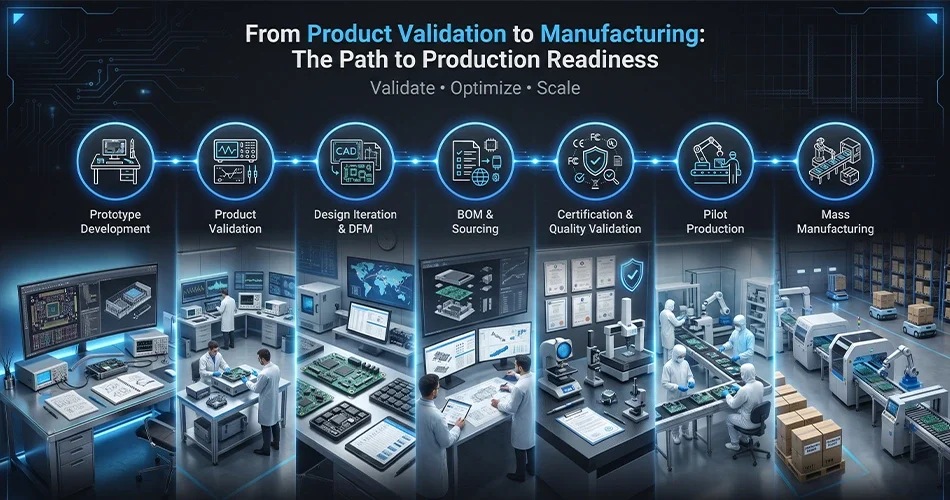
Bringing a new hardware product to market involves more than developing a functional prototype. Before moving into production, product companies need to validate product performance, optimize designs for manufacturing, and ensure they are prepared for scalable production. This requires close coordination among engineering, sourcing, testing, and manufacturing to reduce any bottlenecks before production begins.
This is where an ODM partner makes a difference. By combining product design, engineering, sourcing, and manufacturing expertise, ODM partners help product companies streamline product validation, improve manufacturing readiness, and establish a structured path from concept to production.
This is where an ODM partner makes a difference. By combining product design, engineering, sourcing, and manufacturing expertise, ODM partners help product companies streamline product validation, improve manufacturing readiness, and establish a structured path from concept to production.
Why Product Validation Matters Before Manufacturing
Product validation is the stage where a concept begins to prove its readiness for manufacturing. While a prototype may demonstrate that a product works, validation confirms whether it can be built consistently, meet quality and regulatory requirements, and perform reliably outside controlled testing environments. It also helps uncover design, sourcing, and manufacturing challenges before they become expensive production issues.
Investing time in product validation allows companies to make informed design decisions while changes are still practical to implement. As a result, products enter production with fewer surprises, lower manufacturing risk, and a stronger foundation for scaling.
The product validation process plays a significant role in determining the functional and manufacturing success of the prototype. This stage enables product companies to decide whether a design can be manufactured efficiently and consistently, and scale up adequately while meeting performance, quality, and regulatory expectations. A well-structured validation process helps identify potential challenges across design, sourcing, and manufacturing, so that any changes implemented are easy and budget-friendly.
ODM services are critically important in supporting this stage by bringing together engineering, Design for Manufacturing (DFM), sourcing, prototyping, and manufacturing expertise in a single collaborative process. Rather than managing multiple vendors or investing in separate in-house capabilities, product companies can validate designs more efficiently and build a stronger foundation for production.
Investing time in product validation allows companies to make informed design decisions while changes are still practical to implement. As a result, products enter production with fewer surprises, lower manufacturing risk, and a stronger foundation for scaling.
The product validation process plays a significant role in determining the functional and manufacturing success of the prototype. This stage enables product companies to decide whether a design can be manufactured efficiently and consistently, and scale up adequately while meeting performance, quality, and regulatory expectations. A well-structured validation process helps identify potential challenges across design, sourcing, and manufacturing, so that any changes implemented are easy and budget-friendly.
ODM services are critically important in supporting this stage by bringing together engineering, Design for Manufacturing (DFM), sourcing, prototyping, and manufacturing expertise in a single collaborative process. Rather than managing multiple vendors or investing in separate in-house capabilities, product companies can validate designs more efficiently and build a stronger foundation for production.
What a Good Validation Process Looks Like
A successful product validation process typically implements a prototype-test-iterate approach. The process starts with a small batch of working units subjected to real-world testing parameters, allowing product companies to gather feedback. This helps identify design improvements and refine the product before committing to expensive tooling or full-scale manufacturing. Each iteration helps improve product performance, manufacturability, and overall production readiness. Throughout this process, different departments from engineering, validation and testing work simultaneously to optimize the design and production setup and volume. This structured approach helps minimize design revisions later in the development cycle while building a stronger foundation for scalable manufacturing.
Lower Capital Risk Without Lower Quality
Product validation often involves smaller production runs, but this does not incline towards lowering engineering standards. The decisions implemented during this stage determine the product quality, manufacturing efficiency, and long-term production success. As a result, design improvements can be initiated without extensive rework in the developmental cycle.
With the right ODM partner, product companies can specifically balance cost efficiency with quality. Applying the same engineering discipline, DFM practices, and validation processes moves the pilot to full-scale production. This reduces manufacturing risks and ensures products are designed for long-term scalability from the outset.
With the right ODM partner, product companies can specifically balance cost efficiency with quality. Applying the same engineering discipline, DFM practices, and validation processes moves the pilot to full-scale production. This reduces manufacturing risks and ensures products are designed for long-term scalability from the outset.
Built-In Path to Scale:
One of the strongest reasons product companies opt for ODM services over working with multiple vendors is the continuity they provide from product validation through full-scale manufacturing. The same partner that built your validation batch can scale into mass production without a redesign, because the new product introduction process was planned for volume from day one rather than bolted on afterwards. This continuity also preserves design knowledge, manufacturing documentation, test processes, and supplier relationships throughout the product lifecycle, reducing delays and simplifying the transition from pilot builds to volume production.
Why Product Companies Choose This Model
When evaluating ODM services, product companies look beyond manufacturing capacity. The right ODM partner brings the same level of engineering expertise to pilot builds as it does to full-scale production, ensuring consistency throughout the product development journey. This continuity helps reduce development risks, simplify the transition to manufacturing, and maintain product quality as production volumes increase.
More than short-term cost savings, it is this combination of engineering expertise, manufacturing capabilities, and long-term scalability that makes ODM services a valuable choice for bringing hardware products to market.
More than short-term cost savings, it is this combination of engineering expertise, manufacturing capabilities, and long-term scalability that makes ODM services a valuable choice for bringing hardware products to market.
A Stronger Story for Investors Too
A validation phase backed by a credible ODM partner is also easier to explain to investors than a homegrown prototype built on borrowed lab equipment. Being able to point to certified manufacturing facilities, documented test data, and a clear path to scaled production gives early-stage product companies a more compelling story heading into their next funding round, in addition to the engineering benefits already covered above. It also signals to investors that the team understands how to get from a working prototype to a repeatable, sellable product.
How Rapidise Supports the Journey from Concept to Production
At Rapidise, we believe a successful ODM partnership goes beyond taking a product from concept to manufacturing. It is about validating products at every stage, improving manufacturing readiness, and building a scalable foundation for successful production.
Our Original Design Manufacturing process brings together product design, engineering, Design for Manufacturing (DFM), sourcing, manufacturing, and supply chain expertise into a single, integrated workflow. From prototype development and pilot production to full-scale manufacturing, every stage is supported by a structured validation process that includes consistent engineering standards, DFM analysis, BOM optimisation, design reviews, and certification planning. These validation activities help identify and resolve potential design and manufacturing issues before production, reducing redesigns and improving production readiness, regardless of whether it’s a 50-unit pilot batch or scaling to a 50,000-unit production run.
By combining integrated manufacturing facilities, SMT lines, and cross-functional engineering expertise under one roof, Rapidise maintains continuity between validation and manufacturing throughout the product development journey. Instead of coordinating multiple vendors, product companies can work with a single ODM partner to improve visibility, reduce execution risks, and transition from validated prototypes to scalable production with confidence.
Our Original Design Manufacturing process brings together product design, engineering, Design for Manufacturing (DFM), sourcing, manufacturing, and supply chain expertise into a single, integrated workflow. From prototype development and pilot production to full-scale manufacturing, every stage is supported by a structured validation process that includes consistent engineering standards, DFM analysis, BOM optimisation, design reviews, and certification planning. These validation activities help identify and resolve potential design and manufacturing issues before production, reducing redesigns and improving production readiness, regardless of whether it’s a 50-unit pilot batch or scaling to a 50,000-unit production run.
By combining integrated manufacturing facilities, SMT lines, and cross-functional engineering expertise under one roof, Rapidise maintains continuity between validation and manufacturing throughout the product development journey. Instead of coordinating multiple vendors, product companies can work with a single ODM partner to improve visibility, reduce execution risks, and transition from validated prototypes to scalable production with confidence.
FAQs
Should product companies use ODM services or build an in-house hardware team?
Most product companies benefit from working with an ODM partner during the validation phase, as building an in-house hardware and manufacturing team before validating a product is rarely cost-effective.
What is the best way for a hardware company to validate a product before mass production?
Run a tight prototype-test-iterate cycle with small pilot batches before committing to full-scale tooling and volume production.
Which ODM companies support the prototype-to-production journey?
Look for an ODM partner that supports the complete product development journey, from prototype development and validation to pilot production and full-scale manufacturing. Applying consistent DFM practices and engineering standards across every stage helps minimise redesigns and simplifies scaling.
What role does new product introduction play?
New product introduction bridges the gap between a validated prototype and repeatable mass production, covering certification, BOM optimization, and test jig setup.
How small a batch can an ODM partner typically support for validation?
Many ODM partners can support pilot runs ranging from a few dozen to a few hundred units before scaling to full-scale production. The exact batch size depends on the product complexity, manufacturing process, and validation requirements.
Turn Product Validation into Production Confidence
Validate with confidence through an integrated ODM approach that improves product quality, reduces manufacturing risk, and supports production at scale.
