
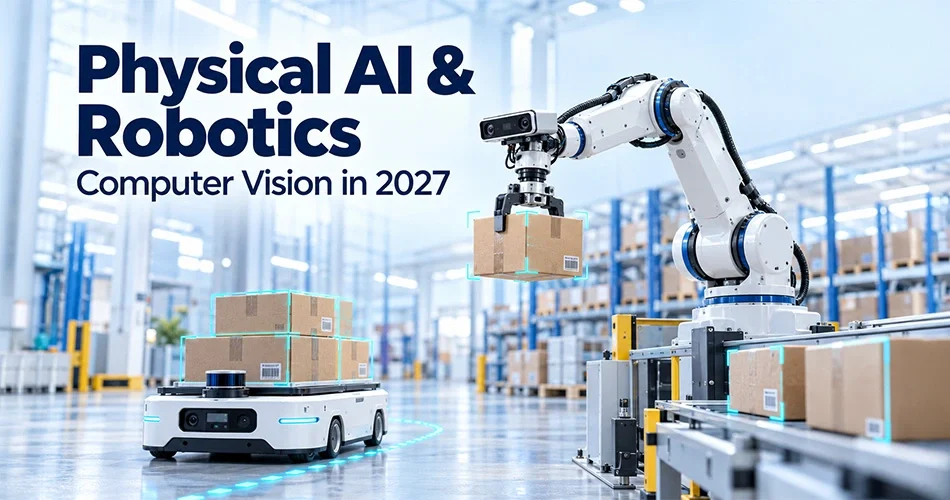
Looking toward 2027, the combination of vision, AI, embedded computing and robotics is expected to support more flexible automation across factories, warehouses, vehicles and service environments. The pace and scope of adoption will depend on cost, reliability, safety requirements and the maturity of each application.
How Computer Vision Gives Robots Better Awareness
A vision-enabled robot does more than capture an image. It may need to detect an object, estimate its position, understand its orientation and decide what action should follow. In a warehouse, this could mean identifying packages and guiding a robotic arm. In manufacturing, the system might locate parts on a moving line and determine whether they are positioned correctly. The quality of the decision depends on the entire perception pipeline, not just the accuracy of one model. Computer vision is the perception layer that makes physical AI practical.
Combining Vision With Other Sensors
Real-world environments create difficult conditions. Lighting changes, objects overlap, surfaces reflect light and people move unpredictably. A robot also has to account for its own motion and sensor limitations. This is why many systems combine multiple inputs such as cameras, depth sensors, inertial data and other machine signals. Sensor fusion can provide a more reliable representation of the environment than relying on a single camera stream.
From Perception to Machine Action
A practical perception-to-action flow can be: camera/depth inputs → image preprocessing → object detection and pose estimation → scene understanding → motion or task planning → deterministic machine control. ROS 2 can be one integration option for coordinating perception and robotics software, but the final architecture depends on the machine and safety requirements.
Edge computing is especially important for physical AI. Robots may need low-latency perception, but AI inference and safety-critical motor control are not the same function. Local processing can reduce perception latency and connectivity dependence, while deterministic control and independent safety mechanisms should govern critical machine actions.
Hardware design must support the workload. AI-enabled robots may need accelerators for vision inference, high-speed interfaces for cameras and sensors, adequate memory and reliable networking. Thermal design and power consumption are also important, especially for mobile machines. Mechanical design, electronics and embedded software need to be considered together because the physical platform can place limits on compute capacity, camera placement and cooling. This is also where machine vision and robotics AI requirements meet.
Software integration is equally important. The vision system needs to communicate with embedded controllers, sensors, actuators and higher-level applications. Timing and determinism matter when a perception result influences a physical action. Teams may use bare-metal software, an RTOS or embedded Linux depending on the control and application requirements. Model deployment, logging, diagnostics and secure updates also become important when robots operate across many sites.
Safety is another major consideration. Ordinary AI vision should not be treated as a standalone robot safety function. The machine needs independent safeguards, defined safe states and a controlled response when perception is unavailable or uncertain. Testing should cover edge cases, occlusions, unexpected objects and sensor failures, with clear boundaries between AI perception, deterministic control and human intervention.
The required architecture depends on the robot’s task and environment. A fixed pick-and-place arm may use a controlled camera view and a narrow set of object classes, while a mobile robot must handle changing viewpoints, moving people and uncertain routes. Define acceptable response time, stopping behavior and fallback states before choosing the model or processor. Test perception under the same lighting, vibration and object variation expected on the factory floor.
Why Edge Processing Matters for Robotics
A robot may use AI to perceive its environment while deterministic control logic governs critical actions. This separation makes validation and troubleshooting easier and allows perception models to improve without changing every safety-related control. It is a practical route to deploying intelligent machines in production.
Physical AI is not simply about putting a larger model into a machine. It requires suitable sensors, efficient compute, embedded software, robotics control and robust testing. Treating it as a complete engineering system helps businesses deploy machines that respond to changing operating conditions.
Engineering a Reliable Physical AI System
For production robotics programs, Rapidise can bring together computer vision, embedded hardware and software, mechanical considerations and system-level validation while keeping AI perception separate from deterministic safety controls. Related capability: mechanical design services Related capability: embedded hardware solutions
Frequently Asked Questions
What is physical AI?
Physical AI refers to AI systems that perceive and act in the physical world, including robots, autonomous machines and intelligent devices.
Why is computer vision important for robotics?
Vision gives robots information about objects, people and environments so they can adapt their actions to changing conditions.
Should robotics AI run at the edge?
For many real-time applications, local inference helps reduce latency and connectivity dependence, while cloud systems can support training and fleet analytics.
What hardware does an AI robot need?
Requirements vary, but systems can include cameras, depth sensors, AI accelerators, memory, high-speed interfaces and embedded control hardware.
Build Smarter Robotics Solutions
Explore how Rapidise combines computer vision, embedded systems and AI to enable intelligent automation and robotics solutions.
