
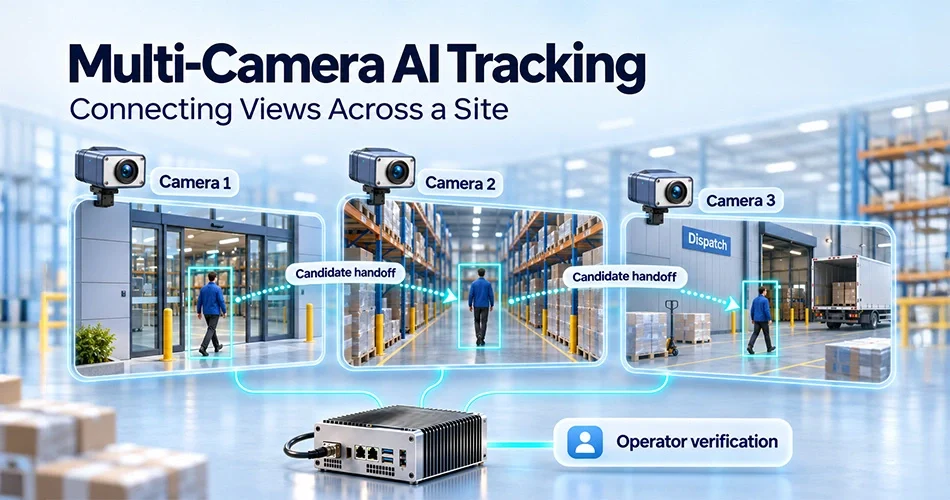
Tracking a person or vehicle in one camera feed is a well-established computer vision task. The challenge becomes much harder when the subject moves between different cameras. Multi-camera AI tracking aims to maintain a consistent identity across overlapping or separate views, helping organizations understand movement through large spaces. This can support security, logistics, retail analytics and industrial monitoring where a single camera cannot cover the complete environment.
How Multi-Camera AI Tracking Works
Detection and Tracking Within Each Camera
Each camera first performs object detection and local tracking. The local track ID belongs to that camera and does not automatically become a site-wide identity. Tracking can continue between detections to reduce compute, while the system records timestamps and track history for later cross-camera matching.
Person Re-Identification and Cross-Camera Handoffs
Cross-camera handoffs are estimates rather than proof of identity. Overlapping views can make a handoff easier, while separated cameras rely on timestamps, camera layout and plausible travel-time windows to decide whether a new observation could match the earlier track. The system should allow unmatched cases when the evidence is insufficient. Camera clocks should be synchronized, and the system should account for camera zones, blind spots and realistic walking or vehicle travel times. If timestamps drift or a camera is moved, previous matching assumptions may no longer hold. Recheck calibration and handoff performance after site changes.
The computing architecture also matters. For example, in a four-camera site, each stream might use lower-rate detection with tracking between detections, while person re-identification runs only on selected person crops during likely camera handoffs. The system must also account for video-decoding overhead, resolution, frame rate, memory and the number of concurrent AI streams. This distributed approach can reduce unnecessary compute while preserving useful site-level context.
Person re-identification can compare appearance features such as clothing or other visual characteristics, but similar clothing, camera angles, lighting and occlusion can create false links. Confidence thresholds, uncertainty handling and operator verification are important when a tracking result could influence a security decision.
Privacy, Testing and Deployment
Privacy and deployment controls should be agreed before rollout: define the purpose of tracking, retention limits, role-based access, audit records and who can review identity matches. Validation should include crowded scenes, lighting changes, partial occlusion, similar-looking subjects and camera outages. Report ID switches, IDF1 or HOTA, false matches and processing speed; detector accuracy alone does not show whether cross-camera handoffs are reliable. Document these checks once in the deployment acceptance plan. Teams should also define how long a candidate match remains eligible after a camera handoff and how the system behaves when no match reaches the required confidence. Review a sample of accepted and rejected matches with site operators, then repeat the evaluation after camera relocation, lighting changes or layout updates. This keeps performance checks tied to real site conditions.
Designing a Scalable Multi-Camera Architecture
For large deployments, identity management can be separated from raw video processing. Edge devices can generate detections and candidate matches, while a central platform maintains site-level context and investigation tools. This makes scaling easier because additional cameras do not require all processing to run on one server. It also allows individual edge nodes to be upgraded without redesigning the analytics platform.
A practical deployment should also include operator tools. Investigators may need to review a timeline, compare camera views and understand why the system linked two observations. Good visualization and confidence information can make automated tracking more useful and easier to validate.
Multi-camera AI tracking is most valuable when it answers a clear operational question, such as where an object moved, whether a person entered a restricted area or how goods travel through a facility. Combining well-positioned cameras, efficient edge processing, robust tracking models and responsible data practices can turn separate video feeds into a connected view of activity across an entire site.
For multi-camera deployments, Rapidise can combine edge video processing, tracking, embedded systems and site-level analytics while accounting for uncertainty, privacy and operator review. Related capabilities: security and surveillance solutions | Edge AI Box
Frequently Asked Questions
What is multi-camera AI tracking?
It is a computer vision approach that maintains object or person tracking across multiple camera views.
How does person re-identification work?
It compares visual and contextual features to estimate whether observations from different cameras belong to the same person.
Can multi-camera tracking run at the edge?
Yes. Edge platforms can process camera streams locally, although larger deployments may use distributed and centralized processing together.
What causes tracking errors?
Occlusion, poor lighting, crowded scenes, similar appearances, camera placement and missing or inconsistent timestamps can all affect accuracy.
Build Smarter Multi-Camera AI Tracking Solutions
Looking to connect multiple camera feeds with intelligent tracking? Connect with Rapidise for advanced computer vision, edge AI and scalable surveillance solutions.
