
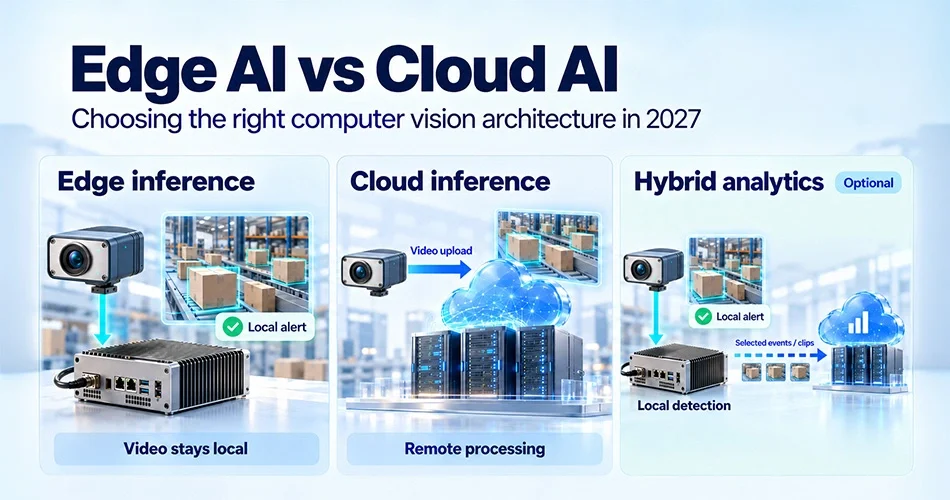
Choosing between edge AI and cloud AI is becoming a practical architecture decision for businesses building computer vision products. Cameras, sensors and video streams generate large amounts of data, but sending everything to a remote cloud can introduce latency, bandwidth costs and privacy concerns. Processing everything locally, on the other hand, requires suitable hardware, software and thermal planning. The right choice depends less on which technology is newer and more on what the application needs to do in real time.
Edge AI vs. Cloud AI: The Core Difference
With edge AI, inference happens close to the camera or sensor. A local processor can detect people, vehicles, defects, unsafe behavior or other events without continuously sending raw video to a central server. This is useful when a system must respond within milliseconds, when connectivity is unreliable, or when video data is sensitive. Local processing can also reduce network traffic because the device can send events, metadata or selected clips instead of every frame.
What should an OEM expect from an EMS provider?
Cloud AI still has an important role. A centralized platform can provide significant computing resources, simplify model management and make it easier to combine information from many locations. Businesses may prefer cloud processing when workloads are not highly time-sensitive, when centralized analytics are more important than instant response, or when devices have limited local compute capacity. Cloud systems can also support large-scale model training, reporting and long-term data analysis.
The decision becomes more interesting when organizations use a hybrid architecture. An intelligent camera or Edge AI Box can perform first-stage detection locally, while the cloud handles aggregation, historical analytics, model updates and fleet management. For example, a warehouse camera could identify a safety event at the edge and immediately trigger an alert, while the event record is later stored centrally for trend analysis. This approach balances responsiveness with centralized visibility.
Hardware and Software Considerations
Hardware selection is a major part of the decision. Computer vision workloads can require CPU, GPU or NPU acceleration, sufficient memory bandwidth and efficient video input. Multiple cameras increase the processing requirement further. The design also needs to consider power consumption, enclosure size, operating temperature, storage, connectivity and the expected model size. Choosing a processor only by its peak AI performance can lead to an inefficient product if the rest of the system cannot support the workload.
Software architecture matters just as much. Teams need an inference runtime, camera interfaces, device drivers, operating-system support and a reliable update mechanism. Models may also need quantization, pruning or other optimization so they can run efficiently on embedded hardware. For products deployed across many sites, remote monitoring and secure firmware or model updates are essential. These engineering details often determine whether a proof of concept becomes a dependable commercial system.
Why Hybrid Architecture Is Often Practical
Cost should be assessed across the product lifecycle. For example, a 20-camera deployment may cost ₹ 4 lakh more in edge hardware but avoid ₹1.5 lakh each year in cloud inference, transfer and storage. The simple payback is about 2.7 years. A low-volume site may still be cheaper in the cloud. Compare device cost, power, connectivity, cloud processing and maintenance together.
No architecture is right for every deployment. Choose edge-first processing when response time, privacy or unreliable connectivity matter most. Choose cloud-first when centralized compute and analytics are more important. A hybrid design can combine both. Whichever approach is selected, retain device authentication, encryption, access controls, secure updates and clear data-retention rules.
| Decision Point | Edge AI | Cloud AI | Hybrid |
|---|---|---|---|
| Latency | Very low and predictable | Network dependent | Low for local actions |
| Camera Count | Best when local compute is sized correctly | Scales centrally | Distributed across edge + cloud |
| Bandwidth | Lower raw-video transfer | Higher for streamed video | Only selected data may be sent |
| Offline Operation | Can continue locally | Limited without connectivity | Local functions can continue |
| Maintenance | Device and software fleet management | Centralized infrastructure | Both layers require management |
What Businesses Should Evaluate Before Choosing
Before choosing, define target latency, camera streams, image resolution, operating temperature, connectivity, privacy, data retention and five-year cost. This makes the decision measurable rather than based only on headline AI performance.
For businesses evaluating a production-ready computer vision deployment, Rapidise works across hardware selection, edge deployment and production engineering, helping teams connect compute, camera interfaces, embedded software, AI inference and product-level validation. Related capability: AI and ML development Related capability: Edge AI Box
Frequently Asked Questions
Is Edge AI better than Cloud AI for computer vision?
It depends on the application. Edge processing is usually better for low-latency and privacy-sensitive workloads, while cloud processing is useful for centralized analytics and large-scale compute.
When should a business use hybrid AI?
Hybrid AI is useful when real-time decisions are required locally but centralized storage, reporting, model management or cross-site analytics are also needed.
Does Edge AI reduce video processing costs?
Does Edge AI reduce video processing costs?
It can reduce bandwidth, cloud inference and storage costs by processing video locally and sending only useful events or metadata.
What hardware is needed for Edge AI vision?
The system may need a CPU, GPU or NPU, suitable memory, camera interfaces, storage and connectivity based on the number of streams and AI models.
Build Smarter Computer Vision Solutions
Develop scalable Edge AI and Cloud AI solutions with Rapidise’s expertise in hardware, embedded software, and AI integration.
