
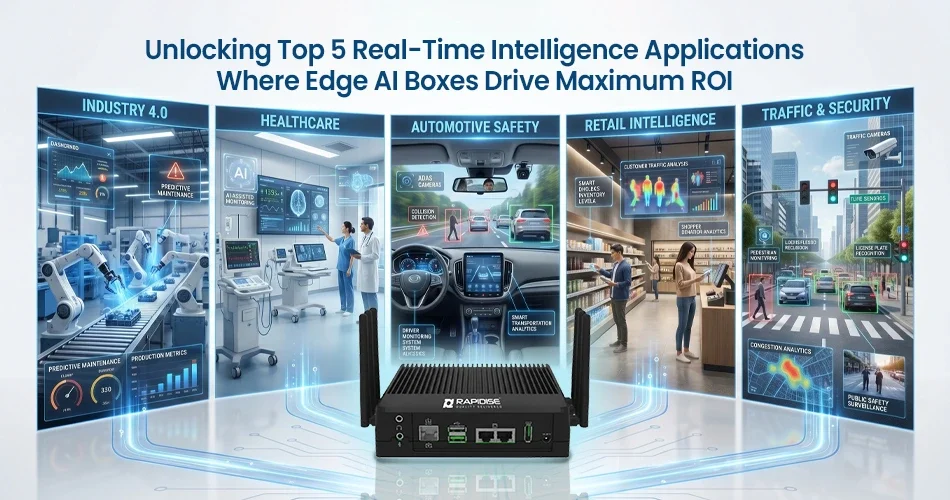
Edge AI is having a moment, but for the person running a factory floor, a hospital ward, or a retail chain, the interesting question isn’t how impressive the technology sounds. It’s whether it solves a specific, costly problem fast enough to matter. An edge AI box is what makes that possible: a self-contained device that runs AI models right where the data is created, instead of sending it to the cloud and waiting for an answer.
This post walks through five places where edge AI boxes are already earning their keep, the kind of granular, line-item use cases that show up in an actual procurement conversation, not just the buzzwords. We’ll also get into what really drives the cost of one of these boxes, and where Rapidise fits if you’re trying to build one rather than just buy one.
This post walks through five places where edge AI boxes are already earning their keep, the kind of granular, line-item use cases that show up in an actual procurement conversation, not just the buzzwords. We’ll also get into what really drives the cost of one of these boxes, and where Rapidise fits if you’re trying to build one rather than just buy one.
What Is an Edge AI Box, really?
An edge AI box is a compact, ruggedized piece of hardware, typically a small enclosure built around a processor (often a GPU or NPU), memory, and the I/O needed to connect cameras, sensors, or industrial equipment, that runs trained AI models locally. There’s no constant round-trip to a data centre and no dependency on internet uptime. Inference happens in milliseconds, right at the source of the data.
That local processing is what unlocks the three things’ businesses actually care about: lower bandwidth costs (you’re not streaming raw video to the cloud all day), tighter data privacy (sensitive footage or patient data can stay on-site), and faster response times (a collision warning that arrives in 200 milliseconds instead of two seconds is the difference between a feature and a hazard).
Edge AI boxes range from small, low-power units running lightweight models for a wearable, up to industrial-grade boxes embedded in a factory line or a vehicle. The use cases below mostly live in that second category.
That local processing is what unlocks the three things’ businesses actually care about: lower bandwidth costs (you’re not streaming raw video to the cloud all day), tighter data privacy (sensitive footage or patient data can stay on-site), and faster response times (a collision warning that arrives in 200 milliseconds instead of two seconds is the difference between a feature and a hazard).
Edge AI boxes range from small, low-power units running lightweight models for a wearable, up to industrial-grade boxes embedded in a factory line or a vehicle. The use cases below mostly live in that second category.
1. Industry 4.0: Catching Problems Before They Get Expensive
On a production line, an edge AI box isn’t there for an impressive demo. It’s there for the unglamorous work that keeps a plant running:
None of that needs cloud round-trip latency. It needs a box sitting next to the machine, watching, and reacting in real time.
2. Healthcare
Sending raw video or biometric data to the cloud for processing introduces both a latency problem and a compliance one. Processing on-site keeps patient data local while still delivering the instant alerting that makes the system clinically useful, not just a logging exercise.
3. Automotive Safety: Where ADAS and DMS Live or Die by Milliseconds
This is the category where edge processing isn’t optional, it’s the entire point. A collision warning system that depends on a cloud round-trip is a system that’s already too late. ADAS and driver monitoring systems (DMS) run inference directly on an edge AI box embedded in the vehicle, because the only acceptable latency here is one a human can’t perceive.
4. Retail Intelligence
The privacy angle matters as much as the insight here. Processing video on an edge AI box inside the store means the footage doesn’t need to leave the building to generate the analytics. The box does the work, and only the aggregated result goes upstream.
5. Security, Surveillance & Smart Traffic: Acting in the Moment
What ties all of these together is that the value is entirely in the speed of the reaction. An incident detected and logged five minutes later in a dashboard is a record. The same incident detected and alerted in under a second is an intervention.
What Actually Drives the Cost of an Edge AI Box
There’s no single sticker price here, and treating it like one is part of what makes a lot of content on this topic feel generic. The real cost of an edge AI box comes down to a handful of concrete decisions:
This is exactly where BoM optimization and DFM (design for manufacturability) review pay for themselves: decisions made at the design stage that determine whether a box is economical to build at scale or stuck as an expensive one-off.
How Rapidise Builds These
A lot of content on this topic treats the edge AI box as something you simply purchase off a shelf and bolt onto your business. For most of the use cases above, that’s not actually how it works. The box needs to be engineered around your specific sensors, your specific environment, and a model trained on your specific data.
That’s the work Rapidise does end to end:
That’s the work Rapidise does end to end:
If you already know the problem you’re solving, whether that’s catching defects on a line or flagging a no-helmet violation on a job site, that’s where the conversation with our team starts. Not a generic spec sheet.
The Bottom Line
Edge AI boxes aren’t valuable because they’re new, they’re valuable because they let a business act on information at the moment it matters: on the factory floor, in the ICU, on the road, in the store, at the gate. The businesses seeing real ROI from them aren’t deploying a generic box. They’re deploying one engineered around a specific, well-defined use case.
If you’ve got a use case in mind, talk to Rapidise. We’ll help you define what the box actually needs to do, then build it, from PCB to firmware to the AI model running on it. Or if you already know the specs, get an instant quote and we’ll take it from there.
If you’ve got a use case in mind, talk to Rapidise. We’ll help you define what the box actually needs to do, then build it, from PCB to firmware to the AI model running on it. Or if you already know the specs, get an instant quote and we’ll take it from there.
Turn Edge AI Performance into Measurable ROI
Accelerate real-time intelligence EDGE AI boxes engineered to improve responsiveness, strengthen data control, and unlock scalable business value.
