
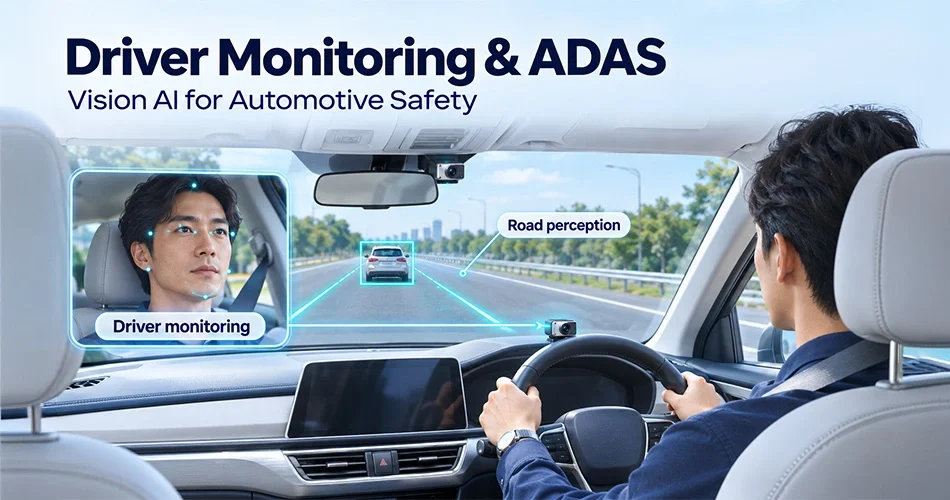
Modern vehicles are increasingly using cameras and AI to understand both the road and the driver. Advanced driver assistance systems help vehicles detect surrounding conditions, while driver monitoring systems focus on the person behind the wheel. Together, these technologies are creating a more responsive safety layer. Vision AI can identify signs of distraction, fatigue, unsafe behavior and road conditions, allowing the vehicle to provide timely warnings or support other safety functions.
How Vision AI Supports Driver Monitoring and ADAS
The system may estimate measurable visual signals such as eye closure, head pose, gaze direction or yawning. Those signals are not the same as a final conclusion that a driver is distracted or drowsy; robust DMS decisions normally use temporal logic and multiple observations to reduce false alerts.
ADAS uses outward-facing cameras and other sensors to support functions such as lane detection, object recognition, pedestrian detection and traffic-sign interpretation. Warning functions and functions that can intervene in vehicle control should be described separately because their safety requirements differ. Each function also has operating limits related to lighting, weather, road markings, speed and sensor availability.
Driver Monitoring Systems
Edge computing is a natural fit for automotive AI because safety-related functions often require low and predictable latency. Evaluation should include frame rate, end-to-end alert latency, processor load, temperature, startup behavior, memory headroom and sustained performance rather than relying on TOPS alone.
Automotive AI development involves more than model training. Camera placement, lens characteristics, image quality, embedded compute, operating-system support and device drivers all influence performance. Validate optimized models on target hardware under realistic driving conditions, including thermal and memory limits.
ADAS and Road-Scene Understanding
For India-facing programmes, notified CMVR requirements make AIS-184 Driver Drowsiness and Attention Warning Systems applicable to M2, M3, N2 and N3 vehicles from 1 October 2027 for new models and 1 January 2028 for existing models (MoRTH response published by PIB, 4 February 2026). Separately, draft notification G.S.R. 904(E), dated 19 October 2026 and published in the Gazette on 22 October 2026, proposes AIS-184 conformity for M1 vehicles if fitted from 1 October 2027, and mandatory fitment for M1 transport vehicles from 1 October 2029. These M1 dates remain draft proposals, not current notified obligations. Verify the latest Gazette and AIS revisions before compliance decisions; consider ISO 21448 (SOTIF) where applicable. Regulatory references: Notified requirements — PIB / MoRTH response (4 February 2026) | Draft G.S.R. 904(E) (published 22 October 2026)
Fleet analytics can help manufacturers identify recurring conditions and monitor system performance. Keep optional cloud functions separate from real-time in-vehicle decisions, with secure communication, controlled updates and appropriate data governance.
Why Automotive Vision Needs Specialized Engineering
Automotive programs also benefit from a staged validation strategy. Recorded datasets can be followed by hardware-in-the-loop testing and controlled road evaluation, but recorded-video tests alone are not enough. Road trials should include different drivers, day/night conditions, occlusions, vibration, camera-position variation and measured false or missed alerts.
The validation plan should define how false alerts, missed events and degraded camera conditions are handled. If the camera is obstructed, disconnected or operating outside its validated conditions, the system should communicate that limitation rather than silently treating the output as reliable.
For vehicle manufacturers and technology suppliers, this also means defining clear ownership between AI, embedded and vehicle-control teams. Interfaces should be agreed early so that sensor data, inference results and diagnostic information move reliably between components.
Automotive safety depends on the interaction of perception, embedded computing and vehicle control. DMS and ADAS should be engineered and validated as complete systems, not isolated AI features.
Designing a Production-Ready Automotive Vision System
A production-ready program should define camera and sensor configuration, target-hardware performance, software interfaces, operating limits, cybersecurity, update strategy, validation data and hardware-in-the-loop and road testing. Document known limitations and the conditions under which each function is intended to operate.
For automotive teams, Rapidise can connect DMS and ADAS development with embedded hardware, software integration and target-hardware validation. Related capability: AI and ML development; embedded software development. Explore related capabilities: AI and ML development | embedded software development
Frequently Asked Questions
What are driver monitoring systems?
DMS use cameras and AI to monitor driver-related visual signals such as attention, gaze or signs of fatigue. A production driver monitoring systems design also needs to account for camera position, lighting, driver variation and validation.
How does vision AI support ADAS?
It helps vehicles interpret camera data for functions such as lane detection, object recognition and pedestrian or traffic-sign detection.
Why is edge processing important in vehicles?
Local processing can provide low and predictable latency without depending on network connectivity.
Can DMS and ADAS use the same AI platform?
They can share parts of the hardware and software architecture, although the models, cameras and safety requirements may differ.
Build Smarter Automotive Safety Solutions with Rapidise
Looking to develop advanced DMS and ADAS solutions? Connect with Rapidise for AI-powered vision systems, embedded software and automotive integration.
