
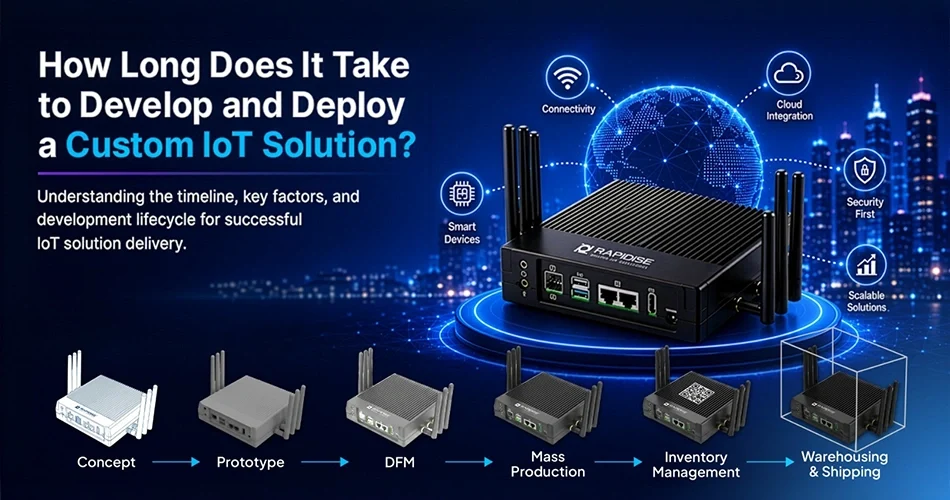
In today’s fast-paced world, businesses are increasingly relying on the Internet of Things (IoT) to streamline their operations and offer enhanced services to their customers. However, one of the most common questions businesses have when considering IoT solutions is, “How long does it take to develop and deploy a custom IoT solution?” The answer to this question depends on various factors, including the complexity of the solution, the type of hardware required, the integration with other systems, and the expertise of the provider.
In this blog, we’ll dive deep into the timeline for developing and deploying a custom IoT solution and what influences this timeline. We’ll also explore how companies like Rapidise, an expert provider, approach custom IoT development solutions to help businesses build smarter, more efficient products.
One of the biggest factors in accelerating IoT deployment timelines is leveraging proven ODM solutions instead of building everything from scratch. With ready-to-deploy hardware platforms and pre-validated architectures, companies like Rapidise help businesses reduce development cycles while maintaining quality and scalability.
In this blog, we’ll dive deep into the timeline for developing and deploying a custom IoT solution and what influences this timeline. We’ll also explore how companies like Rapidise, an expert provider, approach custom IoT development solutions to help businesses build smarter, more efficient products.
One of the biggest factors in accelerating IoT deployment timelines is leveraging proven ODM solutions instead of building everything from scratch. With ready-to-deploy hardware platforms and pre-validated architectures, companies like Rapidise help businesses reduce development cycles while maintaining quality and scalability.
The Factors Affecting IoT Solution Development Time
The timeline for developing and deploying an IoT solution is not the same for every business. Several factors can affect how long it takes, including:
1. Project Scope and Complexity
The timeline is largely dictated by the system’s depth, where simple connectivity takes far less time than multi-layered systems with advanced analytics. Complex industrial or healthcare solutions requiring real-time processing and strict protocols naturally extend the development cycle.
2. Hardware and Sensor Integration
Custom hardware design and manufacturing can add significant time, requiring meticulous synchronization between physical parts and software. Partnering with experienced providers streamlines this phase by ensuring seamless compatibility and rigorous testing across all devices.
Rapidise’s ODM portfolio helps accelerate this process through pre-engineered and field-tested hardware solutions that reduce design iterations and improve reliability.
Rapidise’s ODM portfolio helps accelerate this process through pre-engineered and field-tested hardware solutions that reduce design iterations and improve reliability.
3. Software and Platform Integration
Building platforms for real-time data analysis and cloud storage becomes more time-intensive when integrating with existing business tools like CRM or ERP. Customizing machine learning tools and ensuring smooth data flow across the ecosystem are essential steps that influence the final deployment date.
4. Security Considerations
Implementing robust encryption and authentication protocols is a critical, time-intensive process necessary to protect sensitive data. Expert partners like Rapidise prioritize security from day one, ensuring the system meets industry standards without compromising the launch schedule.
5. Testing and Validation
Comprehensive validation of network performance and data integrity can take weeks to months depending on the solution’s overall complexity. This essential phase ensures the system is scalable and reliable, preventing costly failures once the IoT network is fully deployed.
6. Certification
Certification readiness and compliance requirements can also impact deployment timelines. Experienced ODM partners help businesses navigate these processes more efficiently and reduce commercialization delays.
Understanding the Lifecycle of Developing and Deploying a Custom IoT Solution.
Now that we understand the factors that affect the development time, let’s take a look at the typical timeline for building a custom IoT solution:
1. Planning and Discovery (2–4 Weeks)
This phase focuses on defining the project roadmap, hardware requirements, and data processing methods to align with business goals. Working with partners like Rapidise ensures a solid system architecture is established before any technical development begins.
2. Design and Development (8–16 Weeks)
Engineers build the IoT architecture, integrate software with hardware, and implement critical security and connectivity protocols. The timeline fluctuates based on system complexity, the volume of sensors involved, and the necessity for custom hardware design.
Using pre-developed ODM platforms and validated reference designs can significantly reduce engineering timelines and improve production readiness.
Using pre-developed ODM platforms and validated reference designs can significantly reduce engineering timelines and improve production readiness.
3. Testing and Quality Assurance (4–8 Weeks)
Rigorous functional and connectivity testing is conducted to verify that every device and software component operates flawlessly. Any security gaps or technical bugs are resolved during this period to ensure data integrity before the final launch.
4. Deployment and Integration (4–6 Weeks)
Hardware is installed on-site and configured to sync perfectly with the software platform and existing business ecosystems. This stage includes staff training and final system adjustments to ensure a smooth transition into the live environment.
5. Maintenance and Support (Ongoing)
Continuous success depends on regular software updates, hardware health checks, and proactive troubleshooting to prevent downtime. Long-term support ensures the IoT system remains secure, scalable, and technologically relevant as your business grows.
How Rapidise Accelerates IoT Solution Development
At Rapidise, we specialize in providing end-to-end custom IoT solutions. From initial concept and design to deployment and ongoing maintenance, we work closely with our clients to ensure that they are delivered on time, within budget, and with the highest quality.
With expertise in custom IoT development solutions and a robust ODM portfolio, we offer rapid prototyping, pre-validated hardware platforms, seamless integration, certification-ready designs, and industry-leading security measures to ensure that your IoT system is reliable and deployment-ready.
Our approach to development is agile and adaptable, allowing us to quickly adjust to your business needs and requirements.
With expertise in custom IoT development solutions and a robust ODM portfolio, we offer rapid prototyping, pre-validated hardware platforms, seamless integration, certification-ready designs, and industry-leading security measures to ensure that your IoT system is reliable and deployment-ready.
Our approach to development is agile and adaptable, allowing us to quickly adjust to your business needs and requirements.
Conclusion
The timeline for developing and deploying a custom IoT solution can vary depending on factors such as project complexity, hardware integration, software customization, and security needs. However, with careful planning and collaboration with an experienced provider, businesses can expect to have a fully functional IoT solution within 3–6 months.
For businesses looking to innovate and improve operational efficiency, custom IoT solutions offer unparalleled benefits. Rapidise provides the expertise, speed, and precision necessary to bring your IoT solution to life, helping your business stay ahead in a rapidly evolving technological landscape.
For businesses looking to innovate and improve operational efficiency, custom IoT solutions offer unparalleled benefits. Rapidise provides the expertise, speed, and precision necessary to bring your IoT solution to life, helping your business stay ahead in a rapidly evolving technological landscape.
Accelerate Your NPI Journey with Expert Engineering Support
Streamline design, prototyping, testing, and manufacturing with end-to-end NPI support.
