
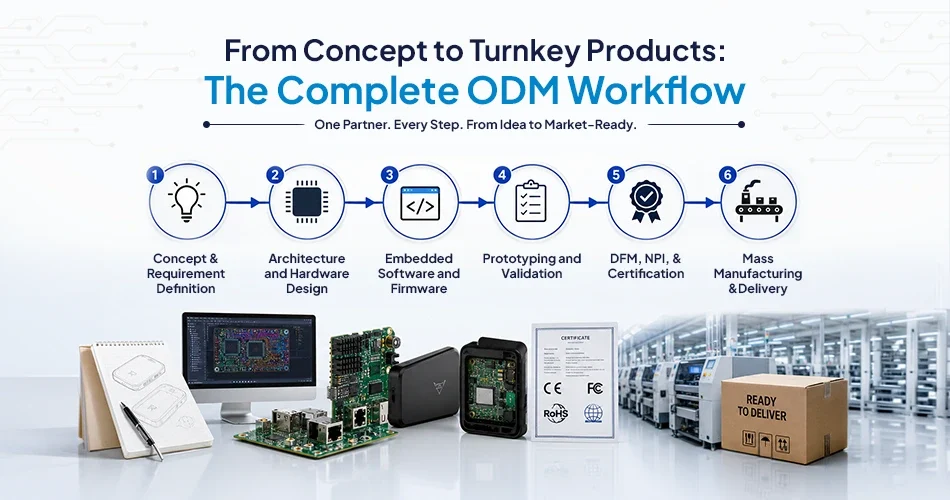
Most founders know they want a finished, manufacturable product. Only a few know what actually happens between a sketch on a whiteboard and a pallet of finished units leaving the factory floor. Understanding the complete ODM workflow makes it far easier to set realistic timelines. Ask the right questions at each stage and avoid surprises along the way to a turnkey product. It also makes it much easier to spot whether an ODM partner is cutting corners or genuinely managing the full process end-to-end.
Step 1: Concept and Requirement Definition
Every program starts with defining what the product needs to do, who it is for, and what constraints, such as cost, certifications, and form factor, will shape the design. This is where the budget, qualification requirements, and RFQ details are finalized before a single component is selected or a line of firmware is written. Skipping or rushing this step is one of the most common reasons later stages run over budget.
Step 2: Architecture and Hardware Design
Architecture and Hardware Design: Engineers translate requirements into circuit design, PCB layout, and component selection, balancing performance against BOM cost and long-term part availability. Hardware architecture is developed across microcontrollers, FPGAs, and high-speed boards, with schematics and PCB layouts optimized for manufacturability from the very beginning rather than being modified later.
Step 3: Embedded Software and Firmware
In parallel, firmware and drivers are built for the chosen hardware platform, whether that is bare metal, RTOS, or full Linux and AOSP. From idea to production, the ODM product development process almost always includes an overlapping hardware-software phase. Software decisions influence component choice, just as component choice determines what software is even possible.
Step 4: Prototyping and Validation
Early prototypes get tested against real-world conditions, not just lab benchmarks. Validation at this stage identifies issues with antenna tuning, thermal performance, or EMC compliance early. This prevents them from becoming expensive production problems that delay product launches.
Step 5: DFM, NPI, and Certification
Design-for-manufacturing review, BOM optimization, and certification planning happen before tooling is finalized. This is also when test jigs are built and the New Product Introduction (NPI) process begins to bridge the gap between engineering and repeatable mass production.
Step 6: Mass Manufacturing and Delivery
PCB assembly, box build, and final packaging are initiated across dedicated SMT and assembly lines, with quality control reviews integrated at every stage instead of waiting for the final stage. The key factor that determines the ODM development timeline from concept to mass production is product complexity. Once tooling and certifications are factored in, most hardware programs take anywhere from several months to over a year.
One Partner, The Whole Sequence
Rapidise manages this entire sequence in-house, from initial requirements to shipped products, through its highly proficient pool of engineers, state-of-the-art SMT and assembly lines, and dedicated Centres of Excellence for R&D and testing. With the entire product lifecycle managed in-house, Rapidise becomes an ideal choice for brands seeking single-vendor continuity. The hardware, software, AI, mechanical design, and manufacturing departments work under one roof rather than being split across multiple disconnected vendors.
Whether you start with a rough concept or a near-final design, a structured ODM workflow transforms your idea into a market-ready product. It also allows an OEM brand to become the manufacturer of record without owning a factory.
Whether you start with a rough concept or a near-final design, a structured ODM workflow transforms your idea into a market-ready product. It also allows an OEM brand to become the manufacturer of record without owning a factory.
FAQs
What does the ODM product development process look like from idea to production?
It typically progresses through requirement definition, hardware and software architecture, prototyping, DFM and certification review, and finally mass manufacturing and delivery, with hardware and software development often happening in parallel.
How long does it take an ODM to go from concept to mass production?
Timelines vary by complexity, but most electronics programs take several months to over a year once prototyping, certification, and NPI are factored in.
Which ODM company manages the entire product lifecycle in-house?
Look for a partner with hardware, software, mechanical, and manufacturing teams under one roof. Rapidise manages the entire product lifecycle internally across its own R&D centers and manufacturing facilities.
Can an OEM brand use an ODM without owning a factory?
Yes. That is the core appeal of the model: an OEM brand can sell a fully engineered and manufactured product without ever operating its own production line.
What stage of the ODM workflow takes the most time?
Certification and DFM reviews often take longer than expected because compliance and manufacturability issues are far less expensive to fix before tooling than after.
Turn Edge AI Performance into Measurable ROI
Accelerate real-time intelligence EDGE AI boxes engineered to improve responsiveness, strengthen data control, and unlock scalable business value.
