
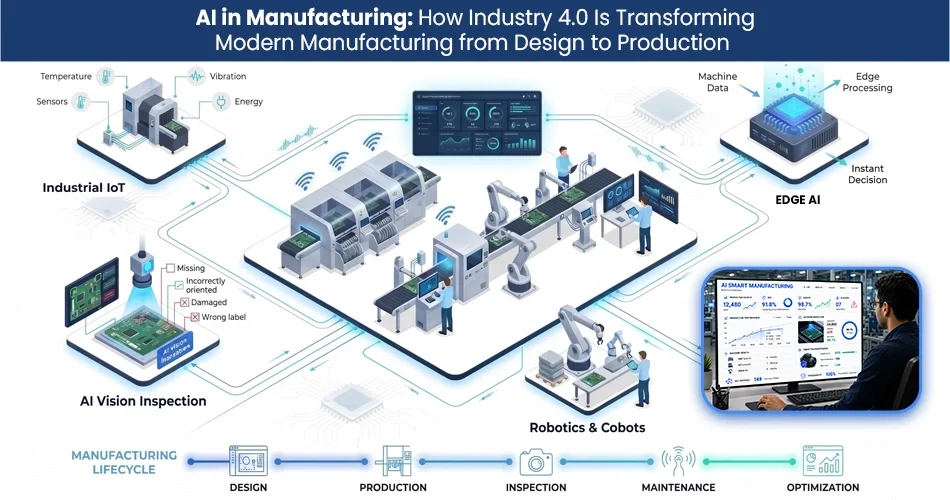
Manufacturing is becoming increasingly connected and data-driven. Machines, sensors, cameras, and production systems generate large amounts of information every day. Artificial intelligence (AI) helps manufacturers turn this data into useful insights, identify problems earlier, improve quality, and make production more efficient.
According to Fortune Business Insights, the global AI in manufacturing market is projected to grow from USD 9.85 billion in 2026 to USD 128.81 billion by 2034.
This growth is being driven by rising demand for smarter automation, real-time production visibility, improved quality control, reduced downtime, and lower operating costs. Manufacturers are also adopting connected machines, edge computing, and advanced analytics to make faster, data-driven decisions across factory operations.
According to Fortune Business Insights, the global AI in manufacturing market is projected to grow from USD 9.85 billion in 2026 to USD 128.81 billion by 2034.
This growth is being driven by rising demand for smarter automation, real-time production visibility, improved quality control, reduced downtime, and lower operating costs. Manufacturers are also adopting connected machines, edge computing, and advanced analytics to make faster, data-driven decisions across factory operations.
What Is AI in Manufacturing?
AI in manufacturing refers to applying artificial intelligence and machine learning to analyse production data, identify patterns, detect anomalies, make predictions, and support manufacturing decisions.
Unlike traditional automation, which mainly follows predefined instructions, AI can learn from historical and real-time data. For example, an AI vision system can detect a missing component during assembly, while predictive maintenance can identify unusual machine behaviour before a failure occurs.
Unlike traditional automation, which mainly follows predefined instructions, AI can learn from historical and real-time data. For example, an AI vision system can detect a missing component during assembly, while predictive maintenance can identify unusual machine behaviour before a failure occurs.
Core Technologies Driving AI in Industry 4.0 Manufacturing
Industrial IoT (IIoT) connects machines and sensors to collect information such as temperature, vibration, energy consumption, machine status, and production output.
Edge AI processes information close to the machine rather than sending everything to the cloud. This is useful when decisions must be made quickly or sensitive production data needs to remain on-site.
Computer vision uses cameras and AI models to inspect products, components, assemblies, labels, and packaging.
Machine learning enables systems to learn from production data for applications such as predictive maintenance, quality prediction, demand forecasting, and process optimisation.
Robotics and cobots combine automation with intelligent systems to perform repetitive tasks while adapting to variations in products and positioning.
Edge AI processes information close to the machine rather than sending everything to the cloud. This is useful when decisions must be made quickly or sensitive production data needs to remain on-site.
Computer vision uses cameras and AI models to inspect products, components, assemblies, labels, and packaging.
Machine learning enables systems to learn from production data for applications such as predictive maintenance, quality prediction, demand forecasting, and process optimisation.
Robotics and cobots combine automation with intelligent systems to perform repetitive tasks while adapting to variations in products and positioning.
How AI Is Transforming the Manufacturing Lifecycle
Product Design and Development
AI can improve manufacturing before production begins. AI-assisted design and simulation can help engineers evaluate product configurations, materials, and operating conditions. Potential issues can be identified earlier, reducing costly changes later.
Production and Process Automation
Production conditions change because of material variations, temperature, tool wear, and machine performance. AI can analyse production data continuously and identify when process parameters need adjustment. This helps maintain consistent output and reduce waste.
AI Vision Inspection and Quality Control
Quality inspection is one of the most practical applications of AI in manufacturing. Manual inspection can be time-consuming and inconsistent. AI-powered vision inspection can examine products against defined quality standards and identify missing parts, incorrect orientation, damaged components, assembly errors, and incorrect labels.
Predictive Maintenance
Unexpected machine failures can cause downtime, production delays, and expensive repairs. Predictive maintenance uses machine and sensor data to identify patterns that may indicate an upcoming failure.
Supply Chain and Production Planning
AI can analyse sales history, inventory, supplier lead times, and production capacity to improve demand forecasting and planning. Better forecasting can help manufacturers manage inventory, identify supply risks earlier, and create production schedules based on actual capacity.
Challenges to AI Adoption in Manufacturing
Legacy Systems
Many factories still use older machines without modern connectivity. They may require sensors, cameras, gateways, or edge devices before AI implementation.
Data Integration
Manufacturing data is often spread across ERP platforms, machine logs, quality records, and maintenance systems. Connecting and standardising this information is essential.
Skill Gap
AI adoption requires both manufacturing knowledge and technical expertise. Teams need to monitor AI performance and update models as products change. Deloitte’s 2026 manufacturing outlook highlights that many manufacturers are still preparing to scale AI.
Cybersecurity
Connecting machines and production systems creates additional cybersecurity risks. Security controls should be considered from the beginning.
The Future of AI in Manufacturing
Agentic AI for Autonomous Factory Operations
AI is moving from systems that identify problems to systems that can recommend or perform actions. Agentic AI can analyse conditions and execute actions within defined limits. Deloitte expects agentic AI adoption in manufacturing to increase from approximately 6% to 24%.
Physical AI and Intelligent Robotics
Physical AI is making industrial robots more adaptable. Robots can increasingly use cameras, sensors, and AI to respond to variations in parts and processes.
Self-Optimising Production Lines
AI-enabled production lines can analyse material variations, temperature, machine performance, and tool wear. This allows parameters to be adjusted automatically while operators focus on supervision and improvement.
Conclusion
Every manufacturing process has different products, inspection requirements, and quality standards. A generic AI model may not understand the specific characteristics of your product. Rapidise develops AI-powered vision inspection solutions trained around your products, processes, and quality requirements.
| AI Solution | Description |
|---|---|
| PCB Inspection | Detects missing, incorrect, damaged, or polarity-sensitive components on printed circuit boards. |
| Assembly Inspection | Verifies the presence, quantity, position, orientation, colour, polarity, routing, and correctness of components such as screws, connectors, wires, shields, labels, clips, and brackets. |
| Packaging Inspection | Checks whether products, accessories, labels, manuals, and other required items are correctly included before dispatch. |
| Barcode & QR Verification | Reads and validates barcodes and QR codes for product identification, traceability, and manufacturing compliance. |
| Custom AI Solutions | Develops AI-powered vision inspection systems tailored to specific manufacturing processes and quality requirements. |
These solutions are supported by Rapidise’s wider AI and ML capabilities across computer vision, edge computing, and predictive maintenance, along with practical manufacturing experience across six SMT and assembly lines.
FAQs
How is AI different from traditional factory automation?
Traditional automation follows predefined rules. AI uses data to identify patterns, detect anomalies, make predictions, and adapt to changing conditions.
Do manufacturers need to replace existing machines to use AI?
Not always. Existing equipment can often be connected using sensors, cameras, gateways, or edge devices, depending on the machine and application.
Where should a manufacturer start with AI?
Start with one clearly defined problem with measurable business value. Quality inspection, recurring machine failures, downtime, and production waste are common areas where AI can deliver measurable improvements.
Transform Manufacturing with AI-Powered Inspection
Improve product quality, reduce inspection errors, and increase production efficiency with AI vision solutions tailored to your products, processes, and manufacturing requirements.
