
AI Is Changing the Way Vehicles Perceive and Respond
For a long time, a vehicle camera was mainly there to capture footage. Sensors collected information, while the driver remained responsible for noticing what was happening around the car. That is changing as vehicles become better at understanding the information they collect.
AI in Automotive allows cameras and sensors to do more than simply record or measure. AI models can recognize lanes, identify vehicles, monitor the driver’s attention and spot situations that may need a warning. In practical terms, this gives the vehicle a better understanding of its surroundings and gives the driver useful information while driving.
This change is particularly visible in ADAS, driver monitoring and connected vehicle systems. Automotive solutions in these areas increasingly integrate telematics, embedded systems and AI-driven capabilities to support safer, more connected and intelligent vehicles.
AI in Automotive allows cameras and sensors to do more than simply record or measure. AI models can recognize lanes, identify vehicles, monitor the driver’s attention and spot situations that may need a warning. In practical terms, this gives the vehicle a better understanding of its surroundings and gives the driver useful information while driving.
This change is particularly visible in ADAS, driver monitoring and connected vehicle systems. Automotive solutions in these areas increasingly integrate telematics, embedded systems and AI-driven capabilities to support safer, more connected and intelligent vehicles.
The Technology Behind AI-Powered Automotive Systems
What are AI-powered automotive systems actually built on? There is no single technology behind them. Cameras, sensors, processors, machine learning and computer vision all have a role to play.
A camera provides the visual input. Sensors can provide additional information about movement or the vehicle’s environment. AI models process that information and look for patterns, objects or events that matter to the particular application.
This is why Edge AI is becoming important in automotive applications. AI processing can happen on the device itself, allowing the system to analyze information locally and respond quickly. With Edge AI and computer vision integrated solutions, automotive systems can process visual data locally for real-time identification, tracking and recognition.
A camera provides the visual input. Sensors can provide additional information about movement or the vehicle’s environment. AI models process that information and look for patterns, objects or events that matter to the particular application.
This is why Edge AI is becoming important in automotive applications. AI processing can happen on the device itself, allowing the system to analyze information locally and respond quickly. With Edge AI and computer vision integrated solutions, automotive systems can process visual data locally for real-time identification, tracking and recognition.
AI Applications Transforming Vehicle Safety
Advanced Driver Assistance Systems (ADAS)
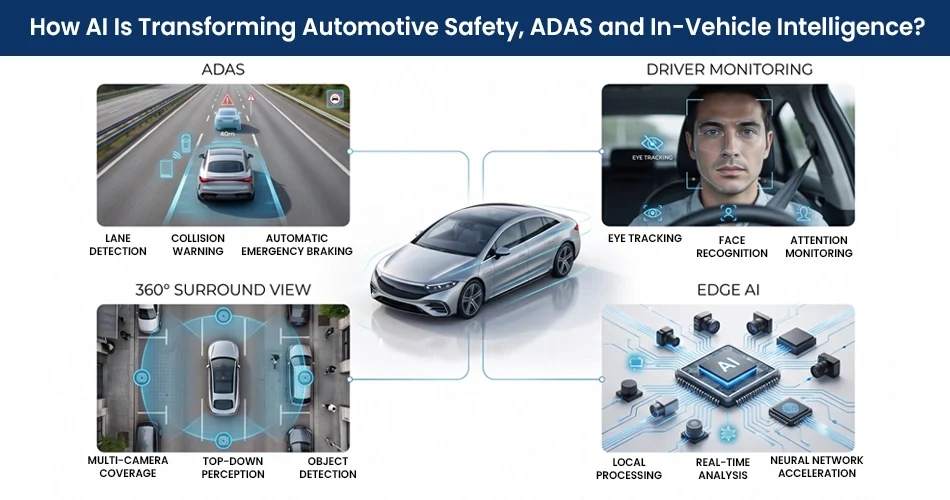
ADAS is one of the most practical practim cal uses of AI in vehicles. Depending on the system, it can support functions such as lane keeping, forward-collision warnings, lane departure warnings, traffic-sign recognition and blind-spot assistance.
The important part is how the system interprets what the camera or sensor is seeing. AI-based computer vision can help distinguish road markings, vehicles and other objects, allowing the vehicle to provide an appropriate warning. ADAS functions in automotive solutions can include advanced features such as lane-keeping assistance, forward-collision warning, traffic-sign recognition, traffic-light recognition and blind-spot assist. These functions can be further enhanced by specialized ADAS and DMS algorithms designed for different automotive edge-processing platforms.
The important part is how the system interprets what the camera or sensor is seeing. AI-based computer vision can help distinguish road markings, vehicles and other objects, allowing the vehicle to provide an appropriate warning. ADAS functions in automotive solutions can include advanced features such as lane-keeping assistance, forward-collision warning, traffic-sign recognition, traffic-light recognition and blind-spot assist. These functions can be further enhanced by specialized ADAS and DMS algorithms designed for different automotive edge-processing platforms.
Blind Spot Detection
Changing lanes looks simple, but a vehicle sitting just outside the driver’s field of view can create a serious risk. Blind spot detection is designed to give the driver another layer of awareness before making that move.
The system uses information from cameras or other sensors to identify nearby objects. AI can help classify that information and determine when an alert is relevant instead of treating every detected object as an immediate danger.
As vehicles use more sensors and cameras, combining information from different sources is also becoming more useful. This approach, commonly known as sensor fusion, can give automotive systems a broader view of the vehicle’s surroundings.
The system uses information from cameras or other sensors to identify nearby objects. AI can help classify that information and determine when an alert is relevant instead of treating every detected object as an immediate danger.
As vehicles use more sensors and cameras, combining information from different sources is also becoming more useful. This approach, commonly known as sensor fusion, can give automotive systems a broader view of the vehicle’s surroundings.
Driver Monitoring System
Safety does not stop at the road ahead. The driver’s condition matters too.
A Driver Monitoring System (DMS) uses an in-cabin camera and AI to observe driver behavior. Depending on the system, it can detect signs of fatigue, distraction, yawning, prolonged eye closure, mobile-phone use or an unfastened seat belt.
So, how is AI used in automotive safety inside the cabin? In this case, it helps turn camera footage into information about the driver’s state. DMS solutions also incorporate on-device processing and real-time driver-state analysis to support features such as fatigue and distraction detection. These systems can be deployed across fleet management, OEM safety systems and ADAS platforms.
A Driver Monitoring System (DMS) uses an in-cabin camera and AI to observe driver behavior. Depending on the system, it can detect signs of fatigue, distraction, yawning, prolonged eye closure, mobile-phone use or an unfastened seat belt.
So, how is AI used in automotive safety inside the cabin? In this case, it helps turn camera footage into information about the driver’s state. DMS solutions also incorporate on-device processing and real-time driver-state analysis to support features such as fatigue and distraction detection. These systems can be deployed across fleet management, OEM safety systems and ADAS platforms.
360° Surround View
A driver cannot always see everything around a vehicle, particularly when parking or moving through a tight space. A 360° surround-view system brings together images from multiple cameras to create a wider picture of the vehicle’s immediate surroundings.
AI and computer vision can make this information more useful by helping identify objects and interpret what the cameras are capturing. The idea is fairly straightforward: instead of relying on one viewpoint, the system uses several views to give the driver better awareness.
AI and computer vision can make this information more useful by helping identify objects and interpret what the cameras are capturing. The idea is fairly straightforward: instead of relying on one viewpoint, the system uses several views to give the driver better awareness.
Emerging Trends with AI in Automotive Automation
One question that is becoming more common is: What is Edge AI in automotive, and why does it matter? The main advantage is local processing. When AI models run on an onboard system, important information does not always have to travel to the cloud before the vehicle can respond. That can be useful for applications where quick response and continuous operation matter.
Sensor fusion is another area worth watching. Cameras, radar, LiDAR and other sensors each provide different types of information. Bringing those inputs together can help create a more complete picture of what is happening around the vehicle.
AI is also becoming more relevant to commercial vehicles and fleet operations. Intelligent cameras can combine video, driver monitoring, incident detection, connectivity and fleet data in one system. These solutions can support applications such as fleet intelligence and smart transportation, where multiple data sources are used to improve visibility and decision-making.
The longer-term direction is toward higher levels of driving automation. But that does not mean every vehicle will suddenly become fully autonomous. The more immediate progress is happening through better perception, faster processing and driver-assistance features that can handle specific situations more effectively.
AI is also becoming more relevant to commercial vehicles and fleet operations. Intelligent cameras can combine video, driver monitoring, incident detection, connectivity and fleet data in one system. These solutions can support applications such as fleet intelligence and smart transportation, where multiple data sources are used to improve visibility and decision-making.
The longer-term direction is toward higher levels of driving automation. But that does not mean every vehicle will suddenly become fully autonomous. The more immediate progress is happening through better perception, faster processing and driver-assistance features that can handle specific situations more effectively.
Conclusion
AI in Automotive is changing what vehicles can do with the information collected by their cameras and sensors. ADAS can help drivers identify hazards, DMS can monitor attention and fatigue, and surround-view systems can provide a broader view around the vehicle.
The next stage will depend on how well these technologies work together. Reliable cameras, suitable processors, computer vision, Edge AI and well-developed algorithms all have to work as part of the same system. For automotive manufacturers and technology companies, that combination is becoming an important part of building safer and more connected vehicles.
At Rapidise, we develop Edge AI, computer vision and embedded systems that enable vehicles to perceive their surroundings, identify risks and respond in real time. These capabilities support ADAS, DMS and connected vehicle applications where real-time intelligence, reliability and responsiveness are critical.
The next stage will depend on how well these technologies work together. Reliable cameras, suitable processors, computer vision, Edge AI and well-developed algorithms all have to work as part of the same system. For automotive manufacturers and technology companies, that combination is becoming an important part of building safer and more connected vehicles.
At Rapidise, we develop Edge AI, computer vision and embedded systems that enable vehicles to perceive their surroundings, identify risks and respond in real time. These capabilities support ADAS, DMS and connected vehicle applications where real-time intelligence, reliability and responsiveness are critical.
FAQs
How is AI used in automotive safety?
AI can analyze information from cameras and sensors to identify potential hazards, support ADAS functions and monitor driver behavior. It can be used for applications such as collision warnings, blind-spot detection and driver fatigue monitoring.
What is Edge AI in automotive?
Edge AI means processing AI models locally on an onboard device rather than depending completely on cloud processing. This can support faster responses and reduce the need to continuously send data to a remote server.
What are the main applications of AI in automotive?
Common applications include ADAS, driver monitoring, blind-spot detection, intelligent cameras, surround-view systems, predictive maintenance and connected fleet solutions.
Can AI detect driver fatigue?
Yes. A Driver Monitoring System can use an in-cabin camera and AI to identify indicators such as yawning, prolonged eye closure and distraction. Rapidise’s DMS includes real-time driver-state analysis and detection capabilities for fatigue and distraction.
Build Smarter, Safer Vehicles with Edge AI
Enhance vehicle safety, driver awareness, and real-time intelligence with AI-powered ADAS, driver monitoring, computer vision, and embedded solutions tailored to your automotive applications.
