
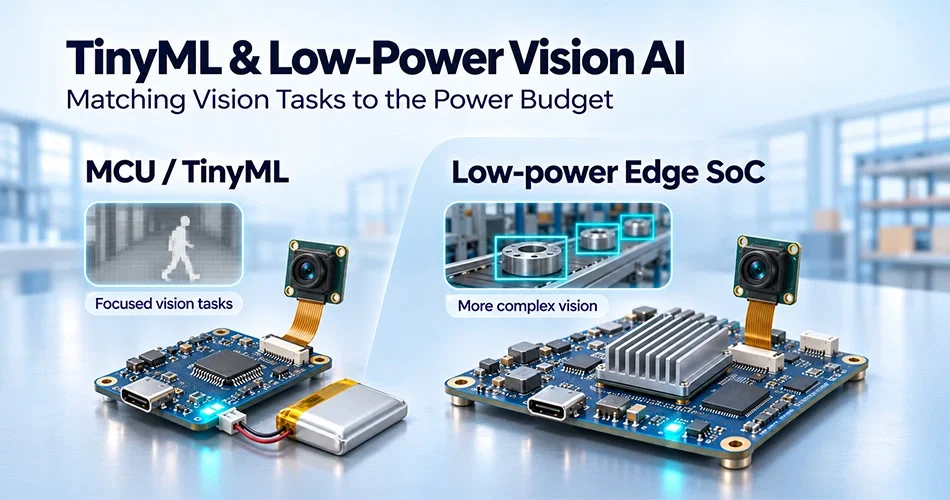
Computer vision is often associated with powerful processors and large neural networks, but low-power deployments fall into two useful categories. MCU-based TinyML runs on very constrained microcontrollers with limited memory and supported operations. Low-power edge AI on Linux or Android-class SoCs has more compute, memory and software flexibility. Both can be efficient, but their deployment constraints are very different.
What TinyML Means for Computer Vision
Selecting a Vision Task That Fits the Device
The first step is choosing a task that fits the device. A microcontroller may not be suitable for a large object-detection model processing high-resolution video, but it may handle a smaller classification or presence-detection task. Defining the minimum useful output can dramatically reduce compute requirements. Instead of asking a tiny device to understand an entire scene, engineers can design a focused model that answers one operational question efficiently.
Reducing Model Size and Compute Requirements
Model optimization is central to low-power vision AI. On an MCU, memory limits include not only model weights but also frame buffers, activation memory and the operations supported by the inference runtime. Quantization, pruning, efficient architectures, lower input resolution and lower processing frequency can help, but every optimization should be measured on the target hardware.
Hardware and software must be designed together. A microcontroller or edge device needs suitable memory, camera connectivity and an efficient inference runtime. Sensor capture, preprocessing and inference should be coordinated so that the device does not waste energy moving or processing unnecessary data. Event-driven processing can help. For example, a low-power system might remain in a lightweight state and perform deeper vision analysis only when a relevant signal occurs. Embedded AI design should keep the capture and inference path efficient.
Battery-powered products benefit greatly from whole-device optimization. Camera power, image capture, sensor wake-up time, preprocessing, inference, wireless transmission and sleep cycles all contribute to the battery budget. Local inference may reduce wireless traffic, but the complete duty cycle must be measured before claiming a battery-life improvement.
Testing TinyML systems requires more than checking model accuracy on a desktop computer. A practical profile should record peak RAM, flash usage, inference time, average current and duty cycle on the actual target hardware. Any battery-life estimate should state assumptions such as image-capture frequency, inference frequency, wireless transmissions and sleep time.
Security and maintainability are important for connected edge devices. Even small devices may require secure boot, authenticated updates and protected communications. If models or firmware need to change in the field, update mechanisms should be designed without creating excessive downtime or power consumption. Product teams should also plan how to monitor performance and diagnose failures when the device is deployed remotely.
Where Low-Power Vision AI Fits Best
Low-power AI also creates opportunities where conventional computer vision systems are too expensive or energy-intensive. Examples can include compact industrial sensors, smart appliances, wearable devices and remote monitoring equipment. The key is to match the AI task to the available resources. When the application is carefully scoped, even modest hardware can provide useful intelligence without requiring continuous connectivity or a large cloud processing budget.
For MCU-based products, the design target should be a narrow task with predictable memory and power needs. For a low-power SoC, a larger model or multiple stages may be practical. The architecture should make that distinction explicit before hardware selection.
| Factor | MCU / TinyML | Low-Power Edge SoC |
|---|---|---|
| Memory / compute | Very constrained | Higher and more flexible |
| OS / software | Bare-metal or RTOS common | Linux/Android-class options |
| Typical vision task | Focused detection/classification | More complex multi-stage vision |
| Power / cost | Very low when carefully designed | Higher, but greater capability |
This approach also makes product design more flexible. If a second-stage model is needed, the architecture must state where it runs: on a second processor, an available NPU or a cloud service. A small MCU cannot simply load a model that exceeds its memory or supported operations. A staged design should therefore define the handoff point and communication path explicitly.
TinyML will not replace higher-performance edge AI for every vision application. Its strength is efficiency. For narrow tasks, long battery life, low cost or compact hardware, a carefully optimized MCU model can be practical. Results depend on treating the model, sensor, processor and embedded software as one system.
For low-power vision products, Rapidise can help align sensor selection, embedded software, AI optimization and edge hardware around the required power, memory and performance budget. Related capability: embedded software development Related capability: embedded hardware solutions
Frequently Asked Questions
What is TinyML?
TinyML refers to machine learning designed to run on very resource-constrained devices such as microcontrollers.
Can TinyML run computer vision?
Yes. Focused and optimized vision models can run on suitable microcontrollers and low-power edge devices.
How do you reduce AI model size?
Techniques can include quantization, pruning, efficient model architectures and reducing input resolution or processing frequency.
Why use low-power vision AI?
It can support battery-powered, compact or always-on products while reducing dependence on network communication and cloud processing.
Build Efficient Low-Power AI Solutions with Rapidise
Looking to deploy computer vision on microcontrollers or low-power edge devices? Connect with Rapidise for embedded hardware, AI optimization and energy-efficient software solutions.
