
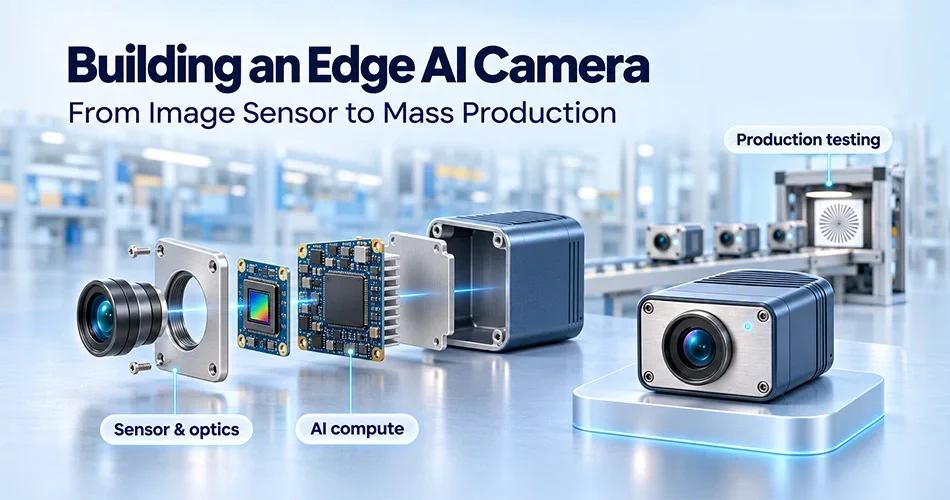
Building an edge AI camera is a system engineering project that starts long before the first prototype. The final product must combine image capture, AI processing, embedded software, connectivity, mechanical design, thermal management and manufacturing requirements. A strong development process begins by defining what the camera must detect, how quickly it must respond, where it will operate and what physical constraints the product must meet.
The Main Building Blocks of an Edge AI Camera
Image quality is the first major consideration. Sensor choice should be tied to the scene: rolling or global shutter behavior, HDR needs, low-light and NIR performance, field of view, lens characteristics and ISP tuning all affect the information available to the AI pipeline. These parameters should be validated under the actual lighting, motion and distance expected after deployment.
AI Chipset and Embedded Processing
The next step is selecting an AI chipset or edge compute platform using measured workload requirements. Teams should compare sustained FPS, memory bandwidth, supported codecs and camera interfaces, power draw and thermal headroom, not only advertised TOPS. A platform that reaches a high peak score but throttles under continuous multi-camera load may be a poor production choice.
Camera Pipeline, Embedded Software and Thermal Design
The camera pipeline can be viewed as: sensor → capture/ISP → preprocessing → AI inference → post-processing/output. Embedded software must manage drivers, buffering, synchronization, recovery from camera or pipeline faults, inference runtimes, diagnostics and secure device updates. This structure helps the product remain maintainable when camera firmware or AI models change.
Mechanical design is another important part of an edge camera. Enclosure size, mounting, ingress protection, heat dissipation and connector placement can affect the electronics and camera performance. AI processors generate heat, and thermal conditions can influence sustained performance. A design that works on an open development board may need significant changes before it can fit into a compact commercial enclosure.
From Prototype to Mass Production
Moving from prototype to mass production requires clear handover gates: prototype validation, DFM/DFT review, component and assembly readiness, end-of-line testing, calibration, secure firmware/model provisioning and traceability. Production documentation, test fixtures, sourcing plans and quality controls should be frozen early enough to avoid discovering manufacturing problems after design release.
Prototype Validation
Prototype validation should test the complete system rather than individual components in isolation. Engineers should evaluate image quality, sensor behaviour, AI accuracy, inference latency, power consumption, thermal performance, connectivity and software stability together. Testing at this stage exposes integration issues while design changes are still manageable.
DFM and DFT Review
Design-for-manufacturing and design-for-test reviews should follow prototype validation and precede production release. They should assess component availability, assembly access, test points, calibration methods, production fixtures, serviceability and the ability to test each unit consistently before the design is frozen.
Production Test and Provisioning
After design validation and DFM/DFT reviews, production testing should verify each manufactured unit against defined acceptance limits. End-of-line checks can cover camera function, image quality, connectivity, firmware and model versions, calibration status and key performance checks. Provisioning should apply secure device credentials and approved software. Traceability should connect each unit to its component configuration and test results.
Product Integration and Model Optimization
Teams should also decide early whether the camera will be developed as a standalone product or as part of a larger system. That decision affects connectivity, APIs, storage, security and update requirements. A standalone smart camera may need its own management interface, while a camera module inside a larger product may rely on a host processor. Defining these boundaries early helps prevent duplicated functionality and makes the transition from prototype to production smoother.
Early cost modeling is useful as well. The bill of materials, compute platform, optics, enclosure and manufacturing test requirements can influence the commercial viability of the camera. Reviewing these factors before design freeze helps avoid expensive changes later.
A successful edge AI camera depends on coordinated hardware, software, AI, mechanical and manufacturing decisions. Start with application requirements, select the sensor and compute platform, design the embedded architecture and prepare the product for production. This reduces redesign risk and creates a clearer path from prototype to market.
For teams taking this camera into production, Rapidise can connect camera and compute selection, embedded software, AI optimization, mechanical considerations and manufacturing engineering from prototype validation through production readiness. Related capability: embedded hardware solutions Related capability: embedded software development
Frequently Asked Questions
What is an edge AI camera?
An edge AI camera combines image capture with local AI processing so it can analyze visual data near the source.
How do I choose an AI chipset for a camera?
Consider model workload, frame rate, camera count, power, memory, video interfaces, thermal limits and required AI acceleration.
Why is image sensor selection important?
AI performance depends on image quality, so sensor characteristics, lens choice and low-light behavior directly affect the vision pipeline.
What is needed for mass production?
Production-ready hardware, manufacturing documentation, component sourcing, testing, calibration and secure firmware or model provisioning are important.
Build Production-Ready Edge AI Cameras with Rapidise
Planning to develop an edge AI camera? Connect with Rapidise for integrated hardware, AI optimization, embedded software and manufacturing solutions.
