
In an increasingly digital world, the need for sophisticated security systems has never been more critical. Traditional video surveillance systems have long been the backbone of security in public spaces, businesses, and homes. However, with the rise of cyber threats, manual monitoring, and false alarms, many organizations are turning to advanced technologies like AI video management systems to improve their security infrastructure. But how exactly does an AI video detect and respond to threats in real time?
In this blog, we will explore the mechanics behind its ability to proactively detect and respond to threats. From AI-driven video management systems to asset tracking devices, we’ll examine how these technologies work together to enhance security, provide actionable insights, and minimize response times.
In this blog, we will explore the mechanics behind its ability to proactively detect and respond to threats. From AI-driven video management systems to asset tracking devices, we’ll examine how these technologies work together to enhance security, provide actionable insights, and minimize response times.
What is an AI Video Management System?
An AI video system revolutionizes surveillance by merging artificial intelligence with video technology to process feeds and make intelligent decisions in real-time. Unlike a traditional video management system, these AI-driven solutions automatically detect suspicious activities or unauthorized access and instantly alert security personnel. They excel at identifying specific objects and individuals, providing a massive advantage for complex tasks like asset management or security patrols. A primary benefit of this software is its capacity to learn from its environment through advanced machine learning algorithms. Over time, the system becomes significantly smarter, continuously refining its ability to distinguish between routine actions and genuine security threats.
How Does an AI Video Management System Detect Threats?
The primary function of is to identify potential threats and suspicious activities within a surveillance area. This is achieved using a combination of AI-driven video management system algorithms and real-time video analytics.
Here are some of the ways in which these systems detect threats:
Here are some of the ways in which these systems detect threats:
1. Motion Detection and Behaviour Analysis
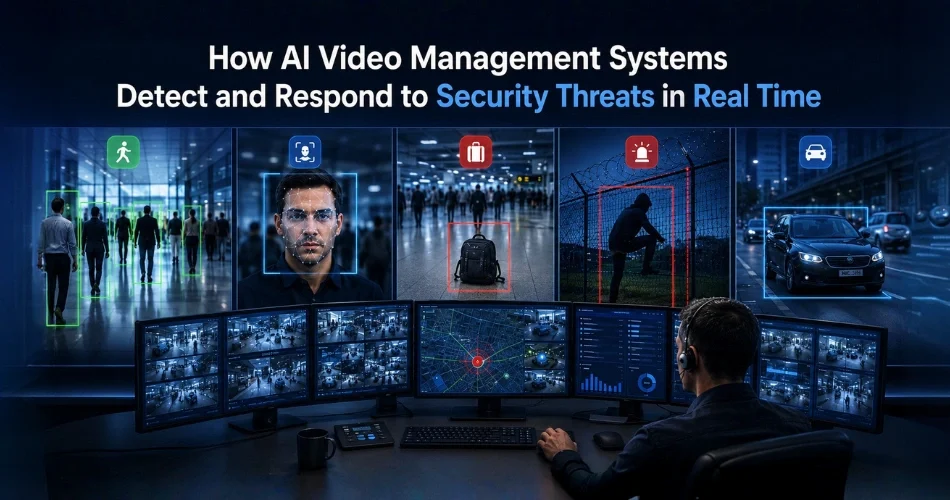
Traditional surveillance systems only offer motion detection, which may trigger false alarms. However, go beyond motion detection by analyzing the behavior of individuals within a given area. Using deep learning models, these systems can distinguish between normal movements (such as people walking or cars driving) and suspicious activities (such as loitering, rapid movements, or individuals attempting to breach security).
2. Facial Recognition
One of the most powerful features of AI-driven video management systems is their ability to recognize faces. These systems use facial recognition technology to compare individuals captured on camera with a pre-existing database of faces. If an individual is recognized as a potential threat or an unauthorized person, the system can send an alert to security personnel, who can then take appropriate action.
3. Object and Vehicle Detection
An AI video can detect and track specific objects, such as bags, boxes, or vehicles, within its field of view. For example, in a crowded area, the system can detect if a suspicious object is left unattended and immediately alert security officers. In addition, vehicle detection allows the system to recognize the entry and exit of vehicles, enabling security teams to monitor traffic flow or identify potential security threats related to vehicle movement.
4. Intrusion Detection
Using geofencing and virtual boundaries, can monitor specific areas and trigger alerts if someone crosses a defined perimeter. For example, if a person attempts to enter a restricted zone or climbs over a fence, the system detects the intrusion and alerts security personnel immediately.
5. Real-Time Analytics and Alerts
Once a potential threat is detected, quickly analyze the data and issue alerts in real time. These alerts can be sent directly to security personnel via mobile devices, email, or an integrated control center. Real-time alerts enable security teams to respond quickly and appropriately, reducing the potential impact of the threat.
How Does the AI Video Management System Respond to Threats?
The real-time response capabilities of an AI video make it stand out from traditional video surveillance. Once a threat is detected, the system can take various actions to mitigate the situation, such as:
1. Alert Notifications
The most immediate response from them is to send alerts to security teams. Alerts can be customized based on the level of threat or type of suspicious activity. For example, if the system detects an unauthorized person in a restricted area, an alert can be sent to security personnel with specific details about the breach.
2. Automatic Lockdown or Access Control
In certain high-risk environments, it can automatically initiate a lockdown or activate access control mechanisms when it detects a security breach. For example, in a building with restricted access areas, the system can lock doors or disable entry points once it recognizes an unauthorized individual.
3. Audio and Visual Deterrents
In some cases, the system can use audio or visual deterrents to prevent further escalation of the threat. For example, once a suspicious activity is detected, the system can trigger a loud alarm or flash lights to alert individuals in the vicinity or deter the intruder.
4. Integration with Other Security Systems
To further enhance the response, system can integrate with other security technologies such as alarm systems, access control systems, or asset tracking devices. This integration allows the system to trigger a comprehensive response, such as notifying local law enforcement or activating security drones.
Why Are AI Video Management Systems Important for Security?
The growing reliance on AI-driven video management systems is transforming how businesses and organizations approach security. With the ability to detect and respond to threats in real time, these systems improve overall safety, reduce response times, and minimize human error.
Moreover, by automating video analysis and threat detection, businesses can reduce the burden on security personnel and increase efficiency. This allows security teams to focus on higher-priority tasks and make better-informed decisions based on real-time data.
Moreover, by automating video analysis and threat detection, businesses can reduce the burden on security personnel and increase efficiency. This allows security teams to focus on higher-priority tasks and make better-informed decisions based on real-time data.
Conclusion
In conclusion, AI video management systems provide a significant advancement over traditional surveillance systems. Through the power of AI-driven video management system software, these systems offer enhanced threat detection, real-time responses, and comprehensive security solutions. With capabilities like motion detection, facial recognition, and object tracking, they offer businesses an effective way to secure their assets, personnel, and facilities.
By integrating technologies such as asset tracking devices and automated response mechanisms, businesses can ensure faster and more accurate security measures, leading to greater overall protection.
If you are looking to enhance your security infrastructure, consider partnering with a leading provider like Rapidise. With our expertise in AI-driven video management and security solutions, we can help you protect your assets in real time.
By integrating technologies such as asset tracking devices and automated response mechanisms, businesses can ensure faster and more accurate security measures, leading to greater overall protection.
If you are looking to enhance your security infrastructure, consider partnering with a leading provider like Rapidise. With our expertise in AI-driven video management and security solutions, we can help you protect your assets in real time.
Ready to transform your surveillance into a proactive defense system?
Discover how Rapidise combines real-time video analytics, smart access control, and advanced object tracking to protect your assets 24/7.
