
Introduction
In an era where products define perception and execution defines credibility; engineering has become one of the most influential forces behind brand success. For technology-driven companies, growth is strongly determined by how effectively ideas are transformed into scalable, reliable, and manufacturable products.
This shift has elevated the role of the engineering partner for market expansion from a tactical supplier to a strategic collaborator. The right partner does not simply build what is specified; they shape how a brand competes, scales, and sustains momentum in increasingly complex markets.
As product lifecycles shorten and expectations rise, engineering excellence is no longer optional; it is a core leadership concern.
This shift has elevated the role of the engineering partner for market expansion from a tactical supplier to a strategic collaborator. The right partner does not simply build what is specified; they shape how a brand competes, scales, and sustains momentum in increasingly complex markets.
As product lifecycles shorten and expectations rise, engineering excellence is no longer optional; it is a core leadership concern.
Why Engineering Choices Are Leadership Decisions
Traditionally, engineering was viewed as a downstream function, separate from strategy. However, in today’s fast-paced business environment, engineering decisions directly impact cost structures, supply chain resilience, and platform flexibility. As a result, leaders need partners who understand the broader business context—not just technical specifications.
Engineering choices, whether related to architecture, components, or platform strategy, must consider unit economics, scalability, trade-offs, and long-term brand implications. When aligned with leadership priorities, these decisions become faster and more confident. Leaders gain a clearer understanding of feasibility, risk, and return on investment. In this way, engineering evolves from a reactive function to a proactive driver of strategic growth.
Engineering choices, whether related to architecture, components, or platform strategy, must consider unit economics, scalability, trade-offs, and long-term brand implications. When aligned with leadership priorities, these decisions become faster and more confident. Leaders gain a clearer understanding of feasibility, risk, and return on investment. In this way, engineering evolves from a reactive function to a proactive driver of strategic growth.
From Innovation to Execution: Closing the Gap
Many companies excel at innovation but struggle when it comes to execution. Prototypes impress, but scaling them reliably under real-world constraints is a challenge. The gap between innovation and execution often stems from fragmented ownership and short-term thinking rather than a lack of talent.
An effective engineering partner focuses on not just “making it work” but on “making it work reliably, at scale.” This requires structured development, clear accountability, and an understanding that success is measured not only by technical milestones but also by market performance. Execution maturity helps organizations move quickly without sacrificing reliability. Timelines become predictable, costs are controlled early, and product launches align with business commitments.
An effective engineering partner focuses on not just “making it work” but on “making it work reliably, at scale.” This requires structured development, clear accountability, and an understanding that success is measured not only by technical milestones but also by market performance. Execution maturity helps organizations move quickly without sacrificing reliability. Timelines become predictable, costs are controlled early, and product launches align with business commitments.
Design for Manufacturing Readiness as a Growth Lever
One of the most overlooked constraint to for the growth of electronics product business is manufacturing readiness. Manufacturing concerns are often addressed late in the development cycle, leading to costly delays and disruptions.
By designing with manufacturing readiness in mind from the start, engineering ensures products are scalable and cost-effective. This includes considerations like assembly efficiency, component availability, and understanding supplier ecosystems. Manufacturing expertise in engineering partners prevents costly redesigns, accelerates ramp-up, and mitigates supply chain bottlenecks, enabling quicker market entry and increased profit margins.
In today’s volatile supply chain environment, manufacturing readiness is a competitive advantage, not just a technical check point.
By designing with manufacturing readiness in mind from the start, engineering ensures products are scalable and cost-effective. This includes considerations like assembly efficiency, component availability, and understanding supplier ecosystems. Manufacturing expertise in engineering partners prevents costly redesigns, accelerates ramp-up, and mitigates supply chain bottlenecks, enabling quicker market entry and increased profit margins.
In today’s volatile supply chain environment, manufacturing readiness is a competitive advantage, not just a technical check point.
Product Lifecycle Ownership: Thinking Beyond Launch
Launching a product is a milestone, but it is not the endpoint. Real brand value is created or destroyed after launch, when products meet customers in the field.
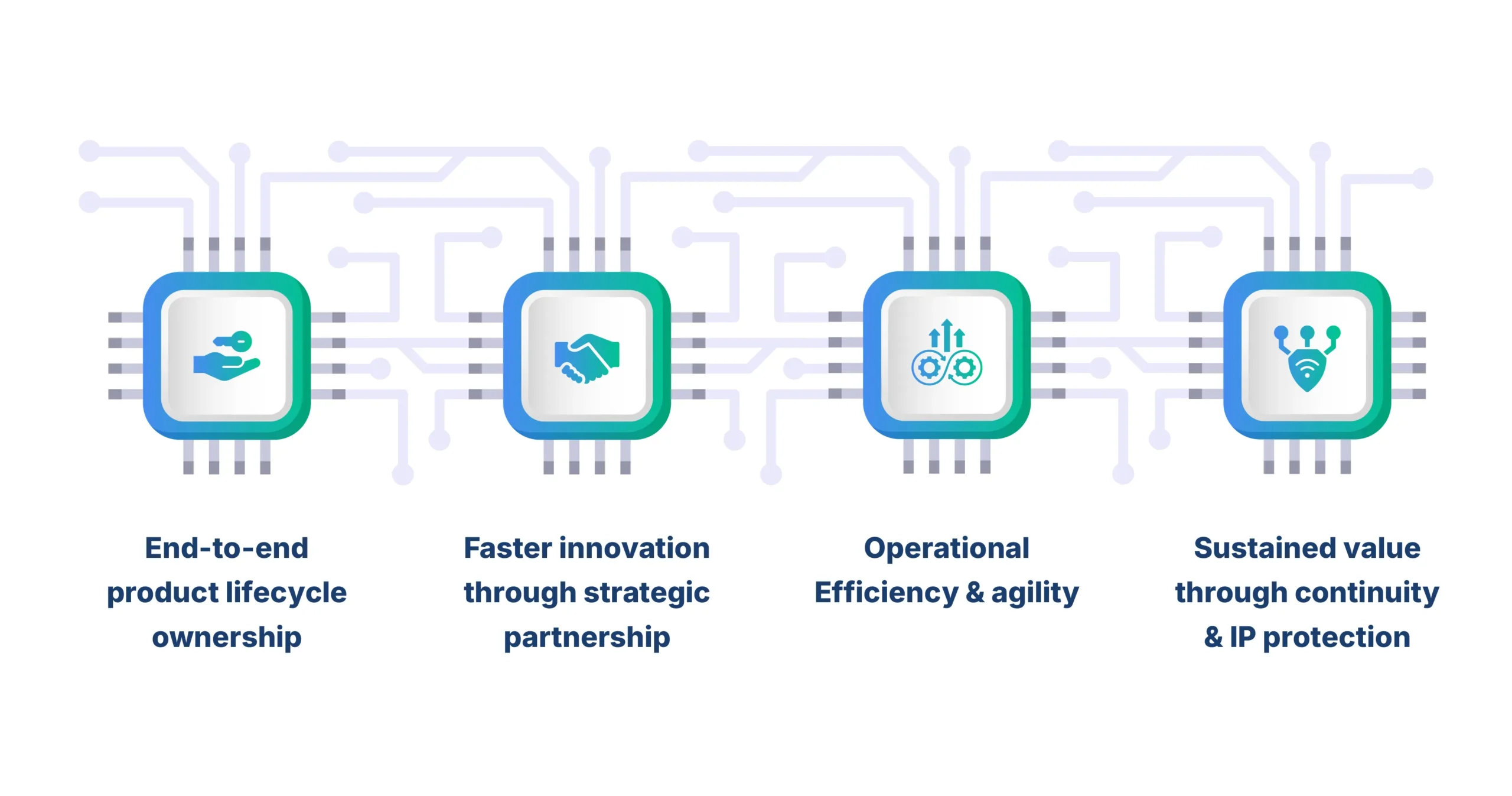
True differentiation comes from end-to-end product lifecycle ownership, where accountability spans production scaling, quality management, field issue resolution, continuous improvement, cost optimization, and rapid portfolio evolution. A strategic design partner amplifies this advantage by enabling shorter design cycles, seamless upgrades with minimal disruption, and the creation of multiple SKUs to address emerging markets and use cases. Additionally, this model also eliminates the need for prolonged hiring cycles and exposure to escalating costs for highly specialized technical talent, allowing organizations to access deep expertise on demand while maintaining agility, predictability, and capital efficiency across the product lifecycle.
Engineering partners who embrace lifecycle ownership remain engaged long after initial delivery. They support manufacturing optimization, respond quickly to market feedback, and help evolve products as requirements change. This continuity reduces knowledge loss and ensures that improvements are implemented efficiently.
A strategic partner also ensures robust intellectual property rights (IPR) management, safeguarding innovations and enhancing long-term product value while protecting competitive advantages in a rapidly evolving market.
For leadership teams, this lifecycle ownership reduces operational complexity. Instead of managing multiple vendors, they work with a partner who understands the product deeply and shares responsibility for its success.
True differentiation comes from end-to-end product lifecycle ownership, where accountability spans production scaling, quality management, field issue resolution, continuous improvement, cost optimization, and rapid portfolio evolution. A strategic design partner amplifies this advantage by enabling shorter design cycles, seamless upgrades with minimal disruption, and the creation of multiple SKUs to address emerging markets and use cases. Additionally, this model also eliminates the need for prolonged hiring cycles and exposure to escalating costs for highly specialized technical talent, allowing organizations to access deep expertise on demand while maintaining agility, predictability, and capital efficiency across the product lifecycle.
Engineering partners who embrace lifecycle ownership remain engaged long after initial delivery. They support manufacturing optimization, respond quickly to market feedback, and help evolve products as requirements change. This continuity reduces knowledge loss and ensures that improvements are implemented efficiently.
A strategic partner also ensures robust intellectual property rights (IPR) management, safeguarding innovations and enhancing long-term product value while protecting competitive advantages in a rapidly evolving market.
For leadership teams, this lifecycle ownership reduces operational complexity. Instead of managing multiple vendors, they work with a partner who understands the product deeply and shares responsibility for its success.
Integration Over Fragmentation
Modern products are complex systems, integrating hardware, software, firmware, cloud connectivity, and manufacturing processes. Fragmented development models struggle with this complexity, leading to misalignment, delays, and accountability gaps.
An integrated engineering approach, where teams share ownership across disciplines, eliminates friction points. Manufacturing feedback directly informs design, and changes are assessed holistically. This integration improves speed, quality, and adaptability, key factors in driving market competitiveness.
An integrated engineering approach, where teams share ownership across disciplines, eliminates friction points. Manufacturing feedback directly informs design, and changes are assessed holistically. This integration improves speed, quality, and adaptability, key factors in driving market competitiveness.
Engineering Services for Business Growth, Not Just Delivery
The most valuable engineering services for business growth extend beyond execution. They combine strategic insight, technical depth, and operational discipline into a single engagement model.
This approach delivers measurable business outcomes:
- Faster and more reliable time to market
- Improved unit economics through early cost optimization
- Higher product quality and customer satisfaction
- Scalable platforms that support future product lines
When engineering is aligned with business growth, it becomes a multiplier rather than a cost center. Each product strengthens the brand, builds customer trust, and creates a foundation for the next wave of innovation.
The Leadership Imperative

For executives, engineering decisions are business decisions. The partners you choose influence not just the product but also how the brand is perceived. The right partner brings execution maturity, manufacturing insight, lifecycle ownership, and a leadership-driven mindset. This allows businesses to scale with confidence and sustain growth.
In a market where consistency matters as much as innovation, engineering excellence becomes integral to the brand’s promise. Companies that treat engineering partners as a strategic asset will outpace those who view it as a transactional service.
In a market where consistency matters as much as innovation, engineering excellence becomes integral to the brand’s promise. Companies that treat engineering partners as a strategic asset will outpace those who view it as a transactional service.
The Engineering Partner: Driving Growth in AI, IoT, and Electronics Product Businesses
Brands aiming to build products rapidly can stay focused on business expansion by delegating engineering execution to a strategic technology partner. This approach significantly reduces development and maintenance costs while providing access to deep, cross-functional expertise throughout the entire product lifecycle. Manufacturing readiness is embedded early, enabling smoother scale-up, predictable timelines, and faster market entry. Companies can retain full ownership of their intellectual property, preserving long-term control and competitive advantages. With leadership-aligned decision-making, execution maturity, and lifecycle accountability, engineering evolves from a tactical function into a strategic growth engine that strengthens brand credibility, scalability, and sustained market impact.
Why Rapidise Is the Right Engineering Partner?
At Rapidise, we redefine engineering partnerships with a focus on measurable outcomes. Our approach centers on execution maturity, providing structured, repeatable delivery from concept to production. Manufacturing readiness is built in from the start, ensuring scalable, cost-effective, and reliable designs.
With proven experience across industries such as automotive, consumer, industrial, and medical, we enable brands to move faster without compromising quality. Our integrated approach reduces risk, shortens development cycles, and supports sustainable growth.
For brands focused on building scalable, enduring products, Rapidise is the strategic partner that delivers.
With proven experience across industries such as automotive, consumer, industrial, and medical, we enable brands to move faster without compromising quality. Our integrated approach reduces risk, shortens development cycles, and supports sustainable growth.
For brands focused on building scalable, enduring products, Rapidise is the strategic partner that delivers.
Choose the Right Engineering Partner
Build products that scale seamlessly and grow your business over time.