
Introduction
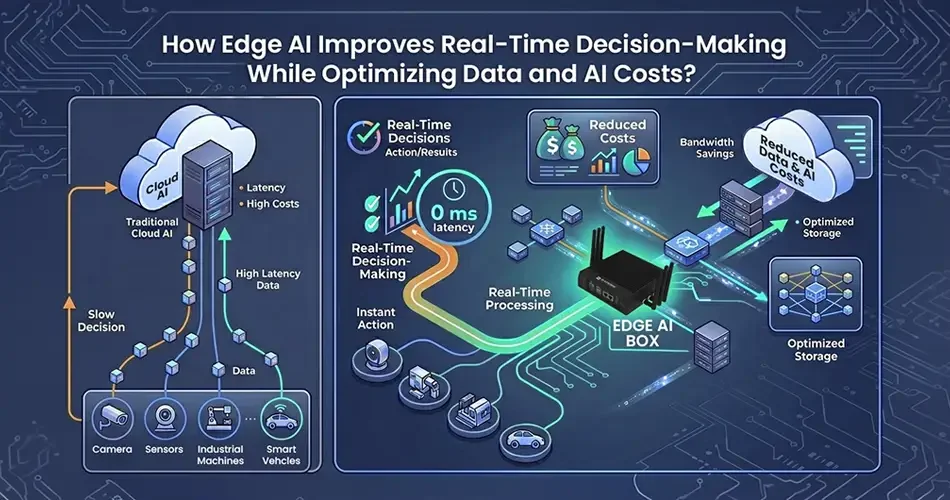
Real-time decision-making has become a strategic capability for modern enterprises operating in fast-moving environments. Across healthcare, automotive, retail, and industrial operations, organizations need insights that drive immediate action. While cloud-based architectures offer scale, they often bring latency, recurring AI processing costs, high data upload expenses, and privacy concerns that can limit efficiency and slow response times.
This is where AI on edge devices is creating a measurable shift. By moving intelligence closer to the data source, an Edge AI device can process information locally, enabling faster analytics, lower bandwidth usage, reduced cloud dependence, and improved reliability. Instead of continuously transmitting large volumes of data for cloud-based inference, businesses can act the moment data is generated. Supported by advanced AI/ML development services, this approach helps enterprises optimize costs, strengthen performance, and build more responsive digital ecosystems
This is where AI on edge devices is creating a measurable shift. By moving intelligence closer to the data source, an Edge AI device can process information locally, enabling faster analytics, lower bandwidth usage, reduced cloud dependence, and improved reliability. Instead of continuously transmitting large volumes of data for cloud-based inference, businesses can act the moment data is generated. Supported by advanced AI/ML development services, this approach helps enterprises optimize costs, strengthen performance, and build more responsive digital ecosystems
Healthcare: Revolutionizing Patient Monitoring and Diagnostics
AI-Based Case Prioritization
In hospital workflows, patients often complete scans, lab tests, or other diagnostics and then wait for their turn to be reviewed by a doctor. AI-enabled systems can help assess test results and patient data as soon as they are available, identifying cases that may need more urgent attention. This helps hospitals prioritize critical patients for earlier consultation and reduce delays in care.
Doctor-Led Clinical Decisions
AI serves as a support layer by improving prioritization and accelerating workflow efficiency The final diagnosis, treatment plan, and care decisions remain with the doctor. This approach helps healthcare providers respond faster while ensuring medical judgment stays at the center of patient care.
Automotive: Enhancing Safety and Autonomous Driving

Autonomous Vehicles
The automotive industry relies heavily on real-time processing. Autonomous vehicles must interpret massive volumes of sensor data – including cameras, radar, and LiDAR – to navigate safely. With AI on edge devices, vehicles can make decisions instantly, even in areas with limited connectivity. Local processing enhances reliability while reducing network dependency.
Advanced Driver Assistance Systems (ADAS)
Modern vehicles integrate advanced safety features such as lane detection, collision avoidance, and driver monitoring systems. These capabilities depend on high-performance AI models operating at the edge. By embedding intelligence directly into vehicle systems, manufacturers enhance safety while delivering smarter driving experiences.
Enhanced Safety and Reduced Latency
Edge intelligence ensures faster reaction times, enabling vehicles to adapt dynamically to changing road conditions. The shift toward localized computing not only improves safety but also supports scalable deployment across automotive fleets.
Retail: Optimizing Customer Experience and Operational Efficiency
Personalized Shopping Experiences
Retailers are using edge intelligence to create more engaging customer journeys. AI-powered in-store devices analyze foot traffic patterns and customer behavior in real time, enabling dynamic recommendations and targeted promotions. By processing data locally, retailers can maintain privacy while enhancing personalization.
Inventory Management
Computer vision systems running on an Edge AI device monitor stock levels continuously, helping retailers reduce shrinkage and improve operational visibility. Automated insights eliminate manual audits and allow teams to respond quickly to changing demand patterns.
Smart Checkout Systems
Edge-powered cameras enable frictionless checkouts by identifying products instantly. This reduces waiting times and improves throughput, transforming the in-store experience into a seamless digital journey.
Dynamic Pricing
Real-time analytics allow retailers to adjust pricing based on demand, inventory levels, or external trends. This agility helps businesses maximize profitability while responding to evolving consumer behavior.
Manufacturing: Enabling Smart Factories
The rise of Industry 4.0 is accelerating adoption of smart manufacturing solutions driven by localized intelligence. Manufacturers are embedding AI directly into machinery to improve productivity, reduce downtime, and optimize resource utilization.
Predictive Maintenance
Sensors powered by AI analyze equipment performance continuously, identifying potential failures before they occur. This proactive approach minimizes disruptions and enhances operational resilience.
Quality Control
Edge-based vision systems inspect products in real time on production lines, ensuring consistent quality standards. Manufacturers can detect defects immediately, reducing waste and improving customer satisfaction.
Supply Chain Optimization
Decentralized intelligence supports faster decision-making across logistics networks. Combined with embedded systems development services, organizations can create connected ecosystems that enhance visibility from factory floor to delivery operations.
Security: Real-Time Threat Detection and Response
Surveillance Systems
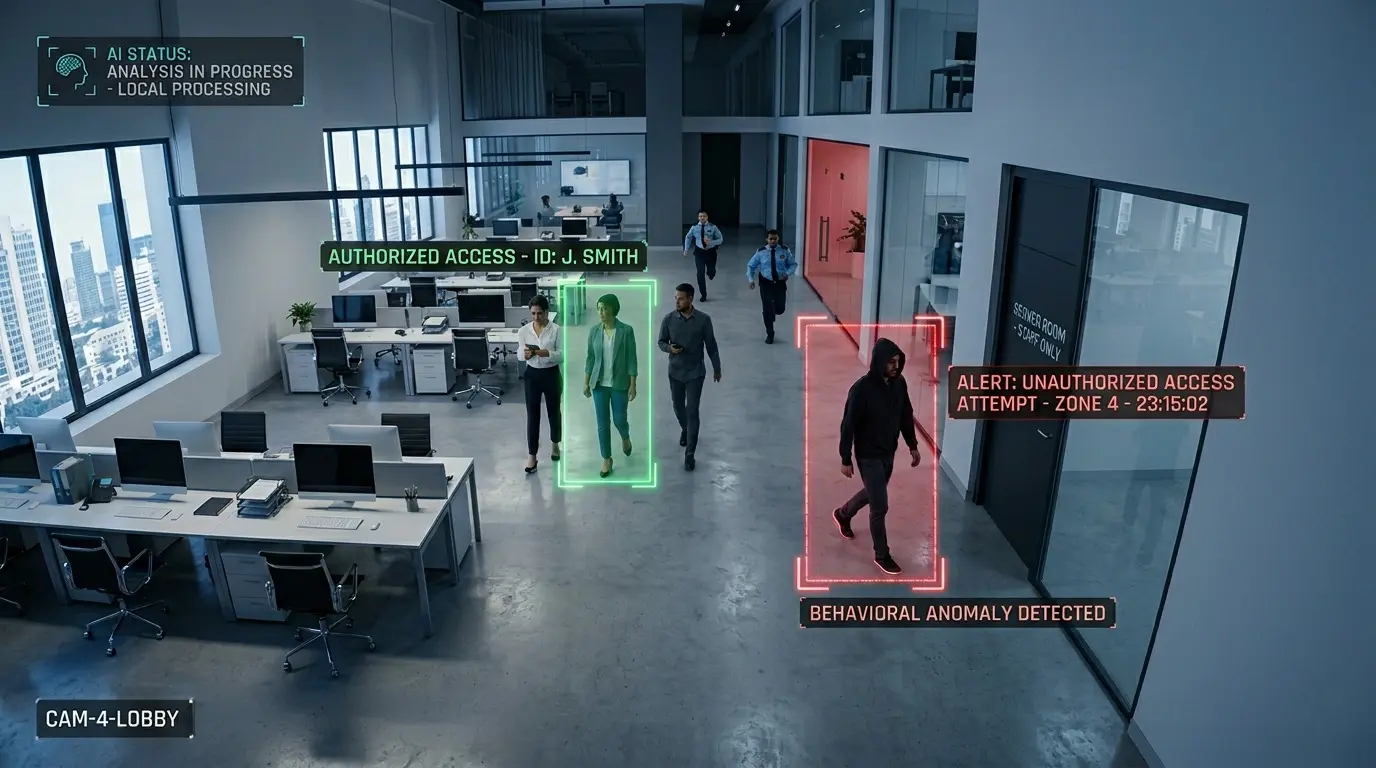
Modern AI surveillance solutions are transforming how organizations monitor physical spaces. Intelligent cameras analyze video streams locally, detecting anomalies such as unauthorized access or suspicious behavior instantly. This reduces bandwidth consumption while enabling rapid incident response.
Threat Detection in Cybersecurity
Edge intelligence extends beyond physical surveillance. Network devices equipped with AI can identify unusual patterns or threats in real time, strengthening enterprise cybersecurity strategies. Localized analysis ensures faster mitigation and improved data protection.
Challenges and Future Outlook
Hardware and System Management Challenges
While edge intelligence delivers powerful advantages, deploying AI across distributed environments requires robust engineering frameworks. Organizations must manage device updates, optimize power consumption, and maintain consistent performance across thousands of endpoints. Building scalable infrastructure often involves collaboration with specialized engineering partners and leveraging embedded systems development services.
Data Privacy and Security Concerns
Processing data locally enhances privacy but introduces new challenges around device security and lifecycle management. Enterprises must implement secure architectures, encrypted communication channels, and reliable update mechanisms to protect sensitive information.
Future Developments
The next phase of edge innovation will be driven by advancements in connectivity and AI optimization. Technologies such as 5G will enable ultra-low latency communication between devices, while AI model compression will allow complex algorithms to run efficiently on lightweight hardware. Federated learning will further enhance collaboration by enabling devices to train models collectively without sharing raw data, creating a more secure and scalable AI ecosystem.
Why Rapidise is the Right Partner for EDGE AI Innovation.
As organizations embrace edge-driven transformation, the need for integrated engineering expertise becomes critical. Rapidise combines deep capabilities in embedded systems development services, AI ML development services, and advanced product engineering to help businesses accelerate deployment of intelligent solutions.
By aligning hardware innovation with scalable software frameworks, Rapidise supports enterprises in building next-generation Edge AI device ecosystems. From automotive electronics and healthcare platforms to industrial automation and AI surveillance solutions, the company enables organizations to move from concept to production with speed and precision.
Few Use Case Examples based on industry. Shared for your reference if you would like to add in your blog
By aligning hardware innovation with scalable software frameworks, Rapidise supports enterprises in building next-generation Edge AI device ecosystems. From automotive electronics and healthcare platforms to industrial automation and AI surveillance solutions, the company enables organizations to move from concept to production with speed and precision.
Few Use Case Examples based on industry. Shared for your reference if you would like to add in your blog
Conclusion
The world of technology is changing rapidly, and businesses must find smarter and quicker ways to develop products. By partnering with a trusted ODM, companies can innovate without the heavy cost and complexity of building everything in-house.
Rapidise delivers advanced engineering solutions through integrated design, rapid prototyping, and scalable manufacturing. Their approach allows organizations to launch high-quality products across the USA, Japan, Europe, and India.
For companies that want to accelerate innovation and reduce time-to-market, working with the right ODM can be the key to long-term success.
Rapidise delivers advanced engineering solutions through integrated design, rapid prototyping, and scalable manufacturing. Their approach allows organizations to launch high-quality products across the USA, Japan, Europe, and India.
For companies that want to accelerate innovation and reduce time-to-market, working with the right ODM can be the key to long-term success.
FAQ’s
What does an ODM company do?
An original design manufacturer refers to a firm that designs and develops products and offer to their customers as white label solutions
What is the difference between OEM and original design manufacturer?
OEM companies manufacture products according to a client’s design, while an original design manufacturer handles both the design and production of the product.
Why do firms opt to use ODM services?
Companies choose ODM services to reduce development time, gain access to engineering expertise, and launch products faster in competitive markets.
Is ODM original design manufacturer suitable for startups?
Yes. Working with an ODM is highly beneficial for startups because it eliminates the need to build expensive in-house engineering teams.
