
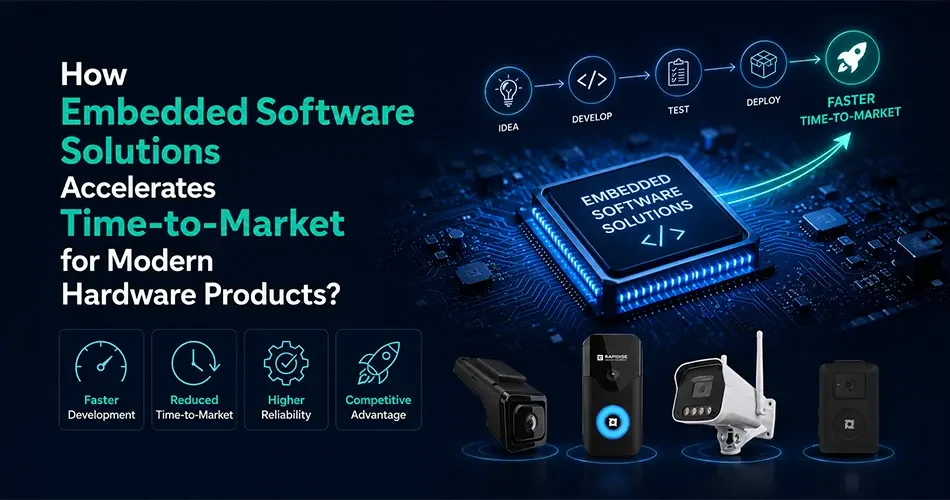
Today’s market demands products that are connected, efficient, and future-proof—and that starts at the embedded level. From automotive systems to high-precision machinery, the “hidden” code is where the real competitive edge lies, embedded software solutions play a pivotal role in shaping modern hardware products. This blog explores how Rapidise is bridging the gap between raw hardware and sophisticated software to redefine product development.
What Is Embedded Software Development?
Embedded software solutions refer to software that is specifically designed to run on embedded systems. An embedded system is a computer system with a dedicated function within a larger mechanical or electrical system. Unlike general-purpose computers, embedded systems are tailored to perform specific tasks and operate within strict resource constraints such as memory, processing power, and energy consumption.
Embedded software development is the process of engineering logic directly into silicon. Unlike general-purpose software, it is purpose-built to control specific hardware functions with high reliability. In a smart thermostat, for instance, the software acts as the central nervous system—integrating inputs from sensors and outputs to actuators to maintain a precise environmental balance. Without this specialized layer, modern hardware would be static and incapable of interaction.”
Embedded software development is the process of engineering logic directly into silicon. Unlike general-purpose software, it is purpose-built to control specific hardware functions with high reliability. In a smart thermostat, for instance, the software acts as the central nervous system—integrating inputs from sensors and outputs to actuators to maintain a precise environmental balance. Without this specialized layer, modern hardware would be static and incapable of interaction.”
Embedded Software Design Services: The Foundation of Modern Devices
The world is increasingly reliant on smart devices. As a result, embedded software design servicesare critical to ensure that these devices work efficiently, reliably, and securely. These services typically involve designing, developing, testing, and deploying embedded software to meet the exact specifications of the hardware it is intended to operate with.
Rapidise bridges the gap between silicon and software. Our holistic approach to embedded design ensures that your automotive, healthcare, or IoT products are built for peak reliability.
Rapidise bridges the gap between silicon and software. Our holistic approach to embedded design ensures that your automotive, healthcare, or IoT products are built for peak reliability.
Why Embedded Software Matters for Modern Hardware Products?
Embedded software solutions enable devices to become “smart” and function as intended. In today’s market, hardware without embedded software is just a mechanical piece. It’s the software that gives the hardware its functionality and ability to perform complex tasks. Here are a few reasons why embedded software is crucial for modern hardware products:
1. Enhanced Functionality
Embedded software transforms static components into interactive features like touch response and battery optimization. Without this intelligence, modern hardware would remain a collection of parts rather than a functional device.
2. Improved Efficiency and Performance
Custom embedded solutions enable hardware to operate at peak efficiency with essential real-time processing. This speed and precision are critical for high-stakes industries like healthcare, automotive, and telecommunications.
3. Security and Reliability
In an era of rising data threats, embedded software acts as the primary shield for user privacy and device integrity. It ensures critical systems, like home security, remain responsive to threats while staying locked against unauthorized access.
4. Cost-Effectiveness
Smart software optimization allows devices to achieve high performance without the need for expensive, overpowered hardware. By making code work harder, companies can lower component costs and significantly improve their product’s bottom line.
What Is an Embedded Software System?
At its core, an embedded software system is a combination of software and hardware designed to perform a dedicated function within a device. The software directly interacts with the hardware to control its behavior, making embedded systems different from general-purpose computing systems.
Embedded software systems can be found in a wide array of products—from washing machines and microwave ovens to more complex devices like industrial robots and medical equipment. These systems are designed to perform tasks with minimal user input and operate autonomously once set up.
For example, in a medical device like an insulin pump, the embedded software controls the flow of insulin based on real-time blood sugar readings. This requires real-time processing, high reliability, and a deep understanding of both hardware and software, which is why embedded software development is such a specialized field.
Embedded software systems can be found in a wide array of products—from washing machines and microwave ovens to more complex devices like industrial robots and medical equipment. These systems are designed to perform tasks with minimal user input and operate autonomously once set up.
For example, in a medical device like an insulin pump, the embedded software controls the flow of insulin based on real-time blood sugar readings. This requires real-time processing, high reliability, and a deep understanding of both hardware and software, which is why embedded software development is such a specialized field.
Is Python or C++ Better for Embedded Systems?
The choice between C++ and Python depends entirely on your project’s specific performance and development goals. C++ is the go-to for high-performance systems, offering the low-level hardware control and memory efficiency required for real-time applications. Python, meanwhile, is ideal for rapid prototyping and testing, allowing developers to iterate quickly despite its slower execution speed. Modern embedded development often balances these two, choosing the language that best aligns with the product’s complexity and time-to-market.
The Future of Embedded Software Development
As hardware products become more intelligent and interconnected, the role of embedded software solutions will only continue to grow. With advancements in AI, machine learning, and the Internet of Things (IoT), the demand for skilled embedded software developers will rise.
At Rapidise, the team is committed to staying ahead of these trends by embracing the latest in AI/ML development, electronics manufacturing, and product engineering. By combining expertise in both hardware and software, they help businesses accelerate their time-to-market while ensuring that their products are both innovative and reliable.
At Rapidise, the team is committed to staying ahead of these trends by embracing the latest in AI/ML development, electronics manufacturing, and product engineering. By combining expertise in both hardware and software, they help businesses accelerate their time-to-market while ensuring that their products are both innovative and reliable.
Accelerate Product Development with Embedded Software Solutions
Build smarter, reliable, and future-ready hardware products with expert embedded software design, development, and integration services.
