
Introduction
Let’s be frank: In today’s relentlessly competitive global market, you face a constant, brutal choice – cut down manufacturing costs without ever compromising the product’s integrity.
Where does that significant cost reduction actually come from? Most companies get it wrong. Cost optimization isn’t a post-design scramble of vendor negotiations or labor cuts ; it starts much earlier, at the design stage itself.
But that’s backward thinking.
The most profound, most impactful savings originate from something far more foundational: an integrated engineering approach, locked in during the initial design phase.
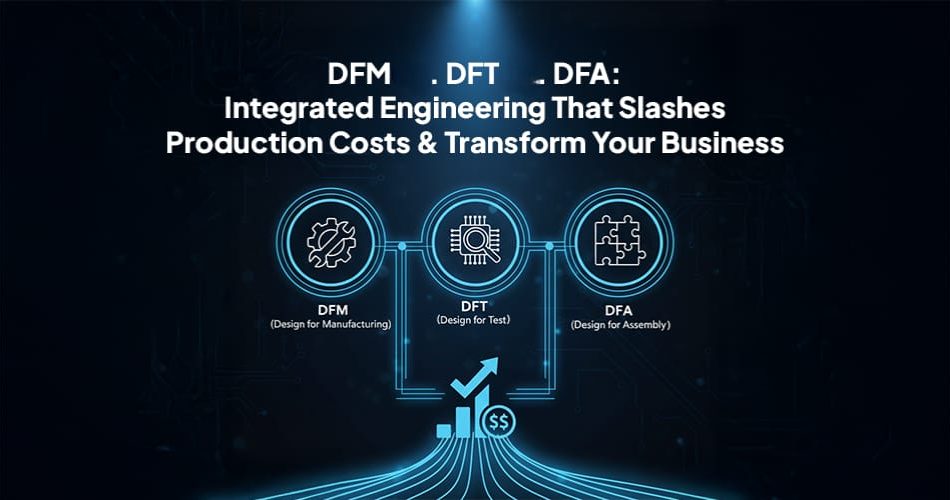
This article isn’t just theory. We’re dissecting the transformative power of three crucial, often-ignored methodologies: Design for Manufacturing (DFM), Design for Test (DFT), and Design for Assembly (DFA).
(DFM, DFT, DFA) together, and the synergy is massive. It can easily cut your product manufacturing cost. That level of savings fundamentally redefines your business’s profitability and market resilience.
Where does that significant cost reduction actually come from? Most companies get it wrong. Cost optimization isn’t a post-design scramble of vendor negotiations or labor cuts ; it starts much earlier, at the design stage itself.
But that’s backward thinking.
The most profound, most impactful savings originate from something far more foundational: an integrated engineering approach, locked in during the initial design phase.
This article isn’t just theory. We’re dissecting the transformative power of three crucial, often-ignored methodologies: Design for Manufacturing (DFM), Design for Test (DFT), and Design for Assembly (DFA).
(DFM, DFT, DFA) together, and the synergy is massive. It can easily cut your product manufacturing cost. That level of savings fundamentally redefines your business’s profitability and market resilience.
What Exactly Are DFM, DFT, and DFA?
Don’t treat them as separate checklists. While each principle has a sharp focus, they are deeply and intimately connected, together providing a complete view of the product’s entire lifecycle.
DFM: Design for Manufacturing
Design for Manufacturing (DFM) is the practice of ensuring your product’s blueprint is perfectly tailored for the actual physical processes used to create the parts. Think of it this way: Is the component easy to make? The main objective is unambiguous: drive down the expense of producing each component without ever sacrificing quality or performance specifications.
- Key Focus Areas: Prudent Raw Material selection, standardization (why reinvent the wheel?), minimizing the need for overly complex or ridiculously expensive machining, and dramatically boosting the first-pass yield rate.
DFT: Design for Test
Design for Test (DFT) isn’t an afterthought-it means baking quality checks directly into the product itself. The goal is simple yet critical: incorporate features into the design that make it simpler, quicker, and more effective to verify quality and locate faults whether it’s on the assembly line or even years later in the field. A smart DFT strategy drastically cuts the agonizing time and expense associated with testing, debugging, and triubleshooting.
- Key Focus Areas: Clear, unambiguous access points for test probes; including built-in self-test (BIST) circuits; and implementing boundary scan (JTAG) protocols, which are non-negotiable for modern complex electronics.
DFA: Design for Assembly
Design for Assembly (DFA) is an obsession with structural simplification. The core mission is to reduce the time and sheer complexity involved in fitting parts together. This means brutally culling the component list, standardizing , minimizing the need to flip or reorient parts, and mistake-proofing the design so components can only mate in the correct way.
- Key Focus Areas: Aggressive reduction of part count, implementing Poka-Yoke (mistake-proofing), smart modular design, and streamlining insertion methods.
The True Power: Integrated Engineering
The error most firms make? Practicing DFM, DFT, or DFA in isolation. It’s like listening to only one instrument in an orchestra. The true, world-class potential lies in their unified, simultaneous application- what we call Integrated Engineering.
Why Integration Isn't Optional Anymore
The sequentially segmented approach to Design -> Manufacture – > inherently flawed. When those inevitable flaws are found downstream by testing or manufacturing engineers, what happens? You face expensive, crippling, market-delaying Engineering Change Note Requests(ECOs).
Integrated engineering is a superior, process improvement methodology where the rules of DFM, DFT, and DFA are consulted and applied concurrently; literally from the first concept sketch. This collaborative, simultaneous workflow drastically minimizes those late-stage fire drills and dramatically accelerates your path to market readiness.
Integrated engineering is a superior, process improvement methodology where the rules of DFM, DFT, and DFA are consulted and applied concurrently; literally from the first concept sketch. This collaborative, simultaneous workflow drastically minimizes those late-stage fire drills and dramatically accelerates your path to market readiness.
The Exponential Benefits
The sequentially segmented approach to Design -> Manufacture – > inherently flawed. When those inevitable flaws are found downstream by testing or manufacturing engineers, what happens? You face expensive, crippling, market-delaying Engineering Change Note Requests(ECOs).
Integrated engineering is a superior, process improvement methodology where the rules of DFM, DFT, and DFA are consulted and applied concurrently; literally from the first concept sketch. This collaborative, simultaneous workflow drastically minimizes those late-stage fire drills and dramatically accelerates your path to market readiness.
Integrated engineering is a superior, process improvement methodology where the rules of DFM, DFT, and DFA are consulted and applied concurrently; literally from the first concept sketch. This collaborative, simultaneous workflow drastically minimizes those late-stage fire drills and dramatically accelerates your path to market readiness.
The Exponential Benefits
When DFM, DFT, and DFA work together, the benefits are not added – they multiply:
- Part Simplification: DFA forces you to simplify, which immediately supports DFM (fewer parts to source/make) and DFT (fewer connections to worry about).
- Inherent Quality: Designing for simple assembly (DFA) virtually eliminates human error, while designing for testability (DFT) guarantees that any manufacturing defects affecting the functionality are addressed almost instantly.
- Lower Production Costs: This is the big prize. Simplified component fabrication, assembly, and testing result in lower material spend, reduced labor hours, and the eradication of crippling rework expenses.
7 Ways DFM, DFT, and DFA Transform Your Business
This integrated methodology isn’t just about saving money in one department; the transformation sweeps across your entire commercial organization.
1. Mastering Supply Chain Optimization Techniques
DFM and DFA are your most potent weapons for supply chain optimization. Why? DFA aggressively pushes for standardization across your entire product portfolio. Result? You dramatically reduce the variety of unique items (SKUs) your procurement team must manage. This translates to:
- Maximum buying power thanks to higher volume purchase agreements.
- Simplified supplier management and fewer logistical bottlenecks.
- A far more robust and flexible inventory management system.
2. Harmonizing DFM and DFA for Extreme Manufacturing Efficiency
The Design for Manufacturing and Assembly (DFMA) pairing is where many see their biggest wins. When a part is engineered to be dirt cheap to make (DFM) and lightning-fast to put together (DFA), you hit peak manufacturing efficiency. A great example is a DFA-driven modular design: it demands DFM-optimized, standardized pieces that fit together logically, thus reducing both the component’s unit cost and the man hours required to manufacture the product.
3. Leveraging DFT for Rock-Solid Supply Chain Management
DFT’s influence isn’t confined to your factory floor; it penetrates the supply chain. By proactively designing in test access points, you gain the ability to perform crucial quality inspections on sub-assemblies and components at the supplier level. What does this stop? Defective parts from ever entering your main assembly stream, ensuring outstanding inbound quality and saving you from the massive cost of defective products.
4. Elevating Product Lifecycle Management (PLM)
Integrating DFM, DFT, and DFA ensures that cost control, quality metrics, and manufacturability are inherently woven into the product’s DNA from the jump; this is the true foundation of sustainable product lifecycle management.
- DFM’s Role in PLM: A DFM-optimized product is naturally more resilient to supply chain shocks or material scarcity because it typically uses standardized, obsolescence risk assessed, multi-sourced material.
- DFA and DFT’s Long-Term Impact: Products designed for straightforward disassembly (a key DFA consideration) and reliable testing (DFT) are significantly less expensive and easier to repair, refurbish, or properly recycle. This extends the product’s profitable life, directly supporting circular economy objectives.
5. Embedding Powerful Process Improvement Methodologies
These design principles are absolutely indispensable tools for executing successful lean manufacturing techniques. DFA’s mission is to eliminate the waste of motion and waiting in the assembly process, while DFT ensures that testing is smooth, rapid, and never creates a production choke point. By simplifying manual steps and ensuring quick fault diagnosis, you eliminate non-value-added time- and increase your operating margins.
6. Maximizing Overall Equipment Effectiveness (OEE)
Overall Equipment Effectiveness (OEE) serves as the ultimate scorecard for your manufacturing operation.
- How DFM and DFA Boost OEE: DFM-friendly designs reduce the complexity of tooling, leading to less machine downtime for adjustment or setup. DFA’s focus on uniform, simple parts reduces machine changeover time, directly boosting throughput.
- Leveraging DFT for Utilization: Superior DFT allows for highly accurate in-process testing. This allows you to catch defects and fix them instantly, preventing them from consuming the valuable time and capacity of expensive machinery further down the line.
7. Drastically Lowering Rework and Warranty Costs
The single biggest financial impact often comes from the reduction in post-production costs. Products designed with DFM (high quality parts), DFA (low assembly error), and DFT (easy defect detection) inherently have:
- Fewer defects on the factory floor (less rework).
- Fewer failures in the field (lower warranty claims and higher customer satisfaction).
Rapidise’s Comprehensive DFx : Making the Cost Cut a Reality
At Rapidise Technology, we didn’t just adopt the DFx (Design for Excellence) philosophy; we engineered it. It is now a robust, proprietary system specifically calibrated to deliver documented, verifiable reductions in your total production cost.
Front-Loaded Analysis
We use sophisticated simulation and advanced analysis tools, drawing on our extensive network of high-quality global manufacturing partners (whether your production needs are in the US or India). We perform DFM and DFA deep dives immediately following the conceptual design phase. We identify and flag costly, risky design elements long before a single penny is spent on a physical prototype.
Collaborative Test Strategy
Our DFT engineers don’t just consult; they work directly with your product design teams. This partnership ensures that efficient test logic and critical access points are organically embedded into the product’s core design. Product verification, therefore, becomes fast, largely automated, and never ends up as a costly, rushed add-on.
Supply Chain Alignment
We leverage our profound expertise in global logistics and sourcing. The goal? To perfectly match your DFx-optimized design with the best, most cost-effective, and highest-quality production sources available. This strategy actively and simultaneously drives down both your material expenditure and tooling investment.
This thoroughly integrated approach is more than just a method for cutting costs. It fundamentally transforms the design into a product that is inherently higher quality, more reliable, and dramatically quicker to scale and deliver to your customers. This is the simple, proven formula that allows our clients to confidently exceed cost-saving target.
This thoroughly integrated approach is more than just a method for cutting costs. It fundamentally transforms the design into a product that is inherently higher quality, more reliable, and dramatically quicker to scale and deliver to your customers. This is the simple, proven formula that allows our clients to confidently exceed cost-saving target.
Summary of Benefits
| Methodology | Primary Goal | Key Business Impact |
|---|---|---|
| DFM | Minimize Part Fabrication Cost | Material cost reduction, higher manufacturing yield |
| DFA | Minimize Assembly Time/Complexity | Reduced labor cost, fewer assembly defects |
| DFT | Minimize Test Time/Cost | Earlier fault detection, reduced warranty / after sales service costs |
Conclusion
Stop chasing minor efficiency tweaks on the assembly line. The path to superior profitability demands a major ideological shift toward Integrated Engineering. By embracing DFM, DFT, and DFA not as separate, annoying hurdles but as a unified, concurrent design strategy, your company can not only hit but surpass the goal of cutting production costs . This approach is the single most important factor in transforming your entire business, from design quality to supply chain optimization and sustainable customer satisfaction.
Book a No-Obligation DFx Consultation Today!
Mandate the collaboration of your design, manufacturing, and test teams at the very start of your next product cycle.
